
Sunday, May 19, 2024
Acts 2:1-11; 1 Cor 12:3-7,12-13; Jn 20: 19-23
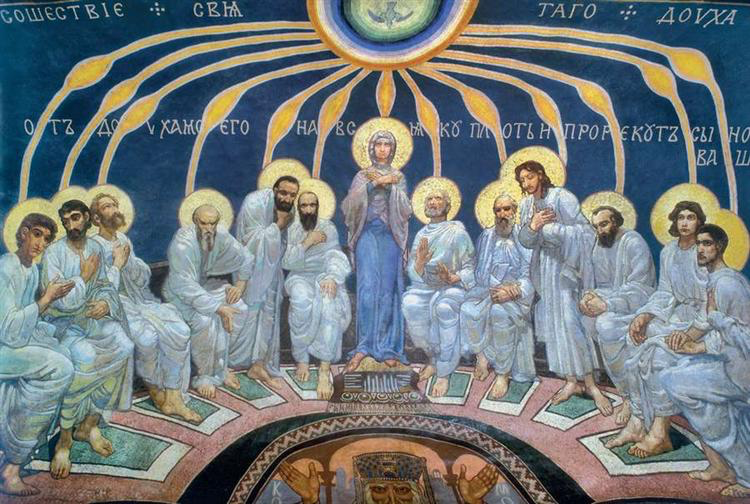
Feast of Pentecost!
The feast of Pentecost concludes the Easter season and celebrates the beginning of the Church.
The Greek word ‘Pentecoste’ means fiftieth. Accordingly, the feast occurs fifty days after the resurrection of Jesus and ten days after his ascension into heaven.
Scholars believe that the earliest followers of Jesus would have come to this Pentecost with a clear understanding of its meaning in their Jewish religion. Pentecost was the Greek name for Shavuot, the Feast of Weeks, celebrated seven weeks after the Passover. Though originally a harvest festival, by the time of Jesus, it had come to be a commemoration of God’s foundational covenant with Israel on Mount Sinai (Ex 19-24).
On that feast, the Lord chose the assembled Hebrews to become His people and gave them a task. ‘Now, if you obey me completely and keep my covenant, you will be my treasured possession among all peoples, though all the earth is mine. You will be to me a kingdom of priests, a holy nation. That is what you must tell the Israelites.’ So, Moses went and summoned the elders of the people. When he set before them all that the Lord had ordered him to tell them, all the people answered together, ‘Everything the Lord has said, we will do’ (Ex 19:5-8).
When Jesus’s disciples were ‘all in one place together,’ the Sinai foundational event was repeated. With the appearance of ‘tongues of fire’, the disciples were all ‘filled with the Holy Spirit and began to speak in different tongues, as the Spirit enabled them to proclaim’ (Acts 2:4).
It was right after Pentecost that Peter, inspired by the Holy Spirit, preached his first homily to Jews and other non-believers, in which he opened the scriptures of the Old Testament, showing how the prophet Joel prophesied events and the coming of the Holy Spirit at Pentecost (Joel 2:28-29).
He also told the people that the Jesus they crucified is the Lord and was raised from the dead, which ‘cut them to the heart’ (Acts 2:37). When they asked what they should do, Peter exhorted them to repent of their sins and to be baptized. According to the account in Acts, about 3,000 people were baptized following Peter’s sermon.
For this reason, Pentecost is considered the birthday of the Church. Peter, the first Pope, preaches for the first time and converts thousands of new believers. The apostles and believers, for the first time, were united by a common language, a common zeal, and a common purpose to go and preach the Gospel.
The importance of the feast is laid out in all three readings of the day.
In the first reading, we find the Spirit enabling the disciples to proclaim the Good News. And people from many different countries heard the mighty acts of God in their own tongues.
The early Church was anointed with the Spirit of the Lord to proclaim His greatness. This was the mandate that the Church received on the day of Pentecost. The early Church could understand the meaning of resurrection in its fullness when it began to live as a resurrected Church after the descent of the Spirit.
In the second reading, Paul reminds the Corinthians of two things. At first, we profess our faith in Christ only through the Holy Spirit. Paul writes, ‘No one can say, ‘Jesus is Lord,’ except by the Holy Spirit. For this reason, we understand faith as God’s gift, and it is considered a theological or infused virtue.
Secondly, Paul reminds us of the spiritual gifts that we are endowed with through the descent of the Spirit. It is the Spirit of God that kindles our hearts to act on His behalf. It is a strong reminder that if we are anointed by the Spirit, we are anointed for something. In that regard, Paul writes, ‘To each individual, the manifestation of the Spirit is given for some benefit.’ Driven by the Spirit, we fulfill God’s will.
In the Gospel, Jesus breathes on the disciples the Holy Spirit. From hereon, the Spirit animates the lives of disciples. Jesus shows the necessity of possessing the Spirit both to function as a Church and to enact the Catholic tradition of sacramental forgiveness.
The descent of the Holy Spirit is foundational for three reasons.
Christian Life: ‘Life in the Spirit’ is the right way to understand the reception of the Spirit. The Spirit becomes the inner guide of the Christian. With or without us realizing it, the Spirit animates our being from within, just as Jesus himself was ‘led by the Spirit’ (Mt 4:1). Unfortunately, the Holy Spirit remains often a forgotten personality. We don’t doubt the existence of air just because we cannot see it visibly. In the same way, the Holy Spirit is the breath of Christian life. How often have we realized the truth?
Christian Charism: As we reflected in the readings, the Spirit enables us with the needed gifts to faithfully discharge our Christian duties. If we are anointed for ‘some benefit,’ what is the specific purpose for which we have been empowered by the Spirit? The gift of the Spirit calls for realization. We fail the Spirit of the Lord if we have not contemplated enough about our charism and been rooted in it to carry out God’s mission.
Christian Duty: Our duty as Christians is largely governed by the insider role of the Spirit. As such, receiving the Spirit is important not only to proclaim the Gospel but also to organize ourselves into a Church. Upon receiving the Spirit, the disciples understand themselves differently. They are empowered to perceive themselves in a new light. If we may ask: ‘What changed the outlook of the early Church? What turned the cowards into courageous witnesses? What drove them across continents to spread the Good News?’ The answer to these questions lies in the descent of the Holy Spirit.
With the descent of the Spirit, the early Church not only imbibed the meaning of resurrection but went on to practice it so that one could witness the transformation in their lives, gifts, and duties.
Let us pray for the gift of the Spirit to be ‘clothed with power’ (Lk 24:49).
Fr. Dhinakaran Savariyar
Discover more from Gospel Delights
Subscribe to get the latest posts sent to your email.