
Sunday, October 22, 2023
Twenty-Ninth Sunday in Ordinary Time
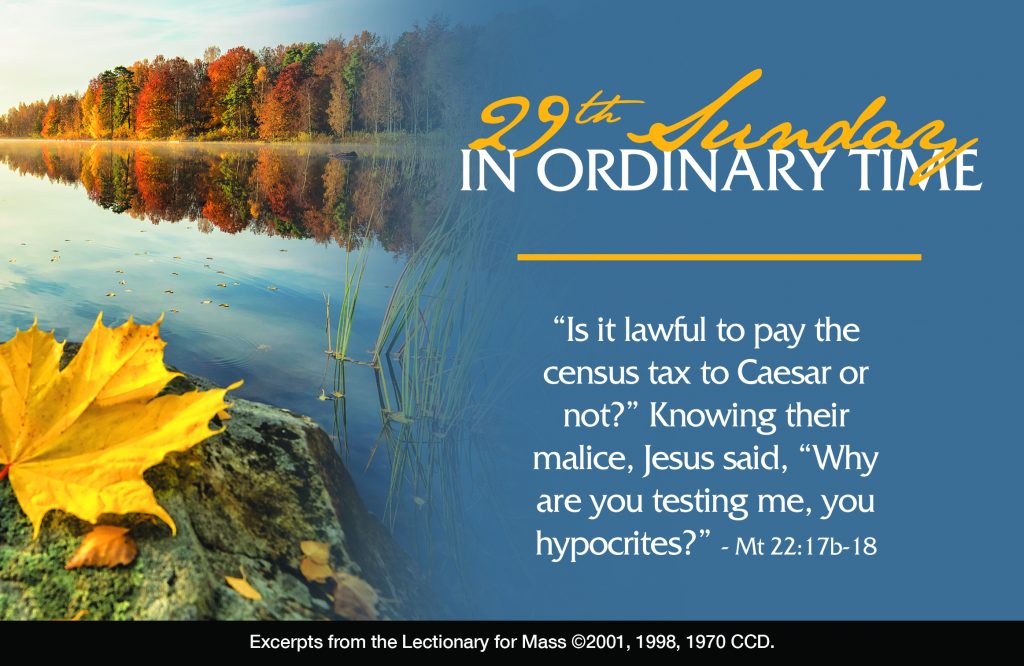
Is 45:1,4-6; 1 Thes 1:1-5; Mt 22:15-21
The twenty-ninth Sunday in ordinary time invites us to understand the sovereignty of God over human life and history as its only author!
The theme of God’s sovereignty runs through all the readings.
The first reading shows how God liberates the people of Israel through Cyrus, a pagan king. But the irony is that King Cyrus himself is not aware that he is being instrumentalized by God. It was not that Cyrus was powerful enough that God chose to instrumentalize him, but that he was invested by God with the power to liberate His people. The first reading leaves behind two important lessons: that God has so ordained human history that it is destined to fulfill His purposes and that God can work miracles through ordinary human agents even without their knowing. Human power is subject to Divine authority.
In the second reading, we find St. Paul thanking the Lord for the good work he could accomplish among the Thessalonians. When Paul gives praise to God, he acknowledges God’s omnipotence while diminishing his role. By recognizing God’s doing, Paul makes God responsible for the goodness of the Thessalonians. As Paul bears witness to God’s grace at work amid His people, he helps us understand that the power and authority of God have no comparisons.
The Gospel is an example of the cunningness of the Pharisees and the Herodians, who appear determined to entrap Jesus in speech. Their question regarding paying taxes to Caesar can be rephrased: ‘Can the people of God express allegiance towards a pagan emperor?’
Jesus is wise in his response. At first, Jesus removes the equation of Caesar with God. Though the Roman coin bore the inscription that Augustus Caesar is god, Jesus regards the emperor’s authority as belonging to the realm of this world. It is restricted to the governance and administration of the region in the king’s possession. As such, Caesar or any other ruler deserves the respect of their subjects, and such honouring does not amount to worship, which only belongs to God.
Secondly, by saying that ‘we should give to God what belongs to God,’ Jesus invites us to reckon the difference between paying taxes to the king and worshiping God. Paying taxes to the king is done with money. Whereas, repaying God is done with our lives. We can only honour God with our goodness and virtues. In his response, Jesus implies that we cannot repay God with what we repay the king. The sovereignty and supremeness of God have no intelligible equivalence.
The words of Jesus leave us with a caution. At times, humans suffer from the ‘Messiah Complex.’ A stark reminder to our bloated ego is the constantly mutating coronavirus, whose mystery we are yet to unravel, even with all our breathtaking advancements in medical technology.
Understanding human limitations is not the same as self-deprecation. The humble recognition of human limitedness only leads to acknowledging the sovereignty and omnipotence of God. In our humility, Christians stoop to conquer. Yes, we kneel before God so that we can stand before the world. True humility is the way to greatness. Let us pray to the Lord for the gift of humility!
Fr. Dhinakaran Savariyar
Discover more from Gospel Delights
Subscribe to get the latest posts sent to your email.