
Sunday, February 22, 2026
First Sunday of Lent
Gen 2:7-9, 3:1-7; Rom 5:12-19; Mt 4:1-11
The first Sunday of Lent highlights that faithfulness to God’s will means resisting temptations.
The three readings of the day help us with a deep reflection on the human inclination to sin and the need to safeguard our holiness, especially during the time of trials.
The first reading covers the story of the Fall. The sin of disobedience in the garden of Eden calls for a profound understanding. The Old Testament understood sin as ‘to miss the mark’ or ‘to fail,’ similar to archers missing their target. The word ‘sin’ would also denote a general failure to live up to God’s standards. Thus, according to the Old Testament, sin becomes a deliberate violation of God’s Law. But how can we evaluate the sin of disobedience by the first parents? Was it only a violation of God’s law or something deeper than that? How can we explain the story of the Fall? The Genesis story of the Fall contains several layers. At first, we must know that the outward act of disobedience is in fact an expression of their inner rebellion. The rebellion arises from the frustration over the ‘limits’ (not to eat from the forbidden tree) to their liberty imposed by God’s precept. Secondly, the sin of disobedience also reeks of the sin of idolatry on the part of the first parents, who suspect God’s love for them because of the limits placed on their freedom. Thus, their sin of disobedience also reveals their misplaced devotion. Thirdly, the sin of disobedience highlights their betrayal of trust. The God who created them was not there to oversee them. The people with free will were expected to act responsibly, but they failed. Finally, the sin of disobedience is motivated by a desire to become like God, empowered with the knowledge of good and evil as promised by the serpent. Thus, the sin of Adam and Eve points to a defiance of God’s authority or, rather, challenges it. The sin of disobedience was an experiment to go beyond the limits of what was acceptable. In sum, the story of the Fall underlines the failure of the first parents to live up to God’s expectations.
The second reading continues the discussion on the story of the Fall from the first reading. In this passage, Paul’s views center around two key arguments. At first, it explains why salvation through Christ was necessary. Paul defends his view by repeatedly contrasting Adam and Christ. He argues that just as Adam’s disobedience brought sin, condemnation, and death into the world, Christ’s obedience brought grace, justification, and life to the faithful. Secondly, Paul shows how Christ’s work reverses Adam’s fall. Paul puts forward Adam as a representative of humanity. Because of Adam’s role in the sin of disobedience, Paul holds that sin entered through one man. He also affirms that sin and death affect all of humanity. However, Paul maintains that while Adam’s disobedience brought condemnation on all, Christ’s sacrifice won justification for all. Thus, if Adam’s act led to humanity’s fall, Christ’s sacrifice restored its righteousness. Thus, though Paul begins on a note of the tragedy of the Fall, he leads us to the victory of the cross. Paul infuses hope into the Roman community by helping them turn away from Eden’s Fall to look at Christ’s victorious Cross.
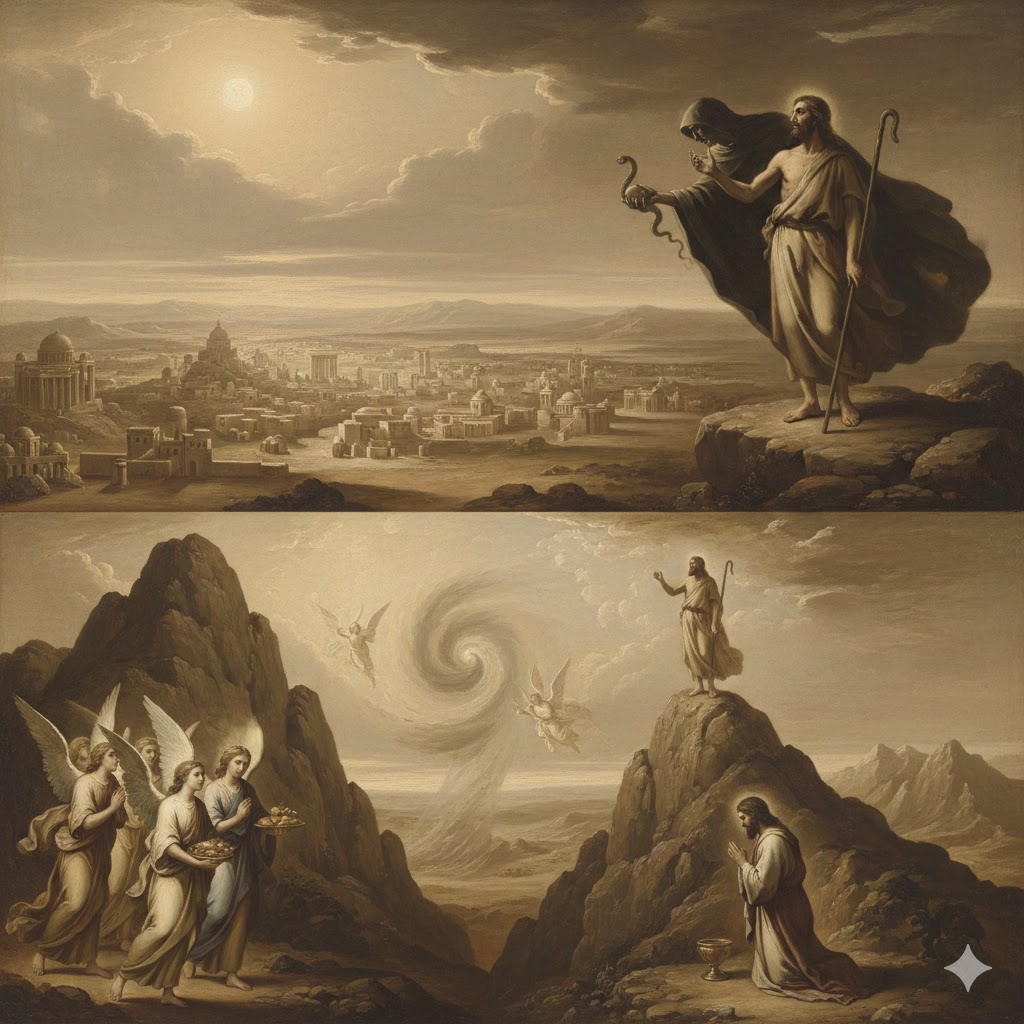
In the Gospel, Jesus is tested in the wilderness. St. Augustine offers a profound connection between the three readings by aligning Jesus’ three temptations with the threefold temptations described in 1 John 2: 16 – the lust of the flesh, the lust of the eyes, and the pride of life – as a reversal of Adam’s fall. Jesus defeated Satan all three times, showing that Jesus righted Adam’s wrongs.
For Augustine, the first temptation that Jesus faced was the ‘lust of the flesh’ when the devil asked Jesus to turn stones into bread. Augustine views this as a temptation to satisfy one’s physical and sensual pleasures. For him, lust of the flesh would mean a life dominated by the senses: gluttony, slavish pleasures, lax morals, inordinate material desires, etc. Thus, it is a temptation to act without regard to the will of God.
For St. Augustine, the second temptation (the third one in the text) that Jesus faced was the ‘lust of the eyes’ when the devil asked Jesus to take a look at the kingdoms of the world. The lust of the eyes refers to an inordinate desire to possess what we see. It means that the one who beholds is captivated by an outward show of materialism. While owning things is not in itself sinful, an inordinate desire to have anything contrary to God’s will is sinful.
For St. Augustine, the third temptation (the second one in the text) that Jesus faced was the ‘pride of life’ when the devil asked Jesus to throw himself down from the temple. This is a temptation to test God to gain recognition. Hence, it indicates the arrogant spirit of self-sufficiency and a pride in what life can offer us. Pride of life includes all false views of pleasure, possession, and superiority. The empty vainglory leads to the person’s downfall.
Thus, in his teaching, St. Augustine reasserts the Pauline view that Jesus, the last Adam, conquered the temptations to leave behind a model for us to overcome our temptations.
Let us pray that we may learn from Jesus how to resist the temptations to our spiritual growth and excellence.
Fr. Dhinakaran Savariyar
Discover more from Gospel Delights
Subscribe to get the latest posts sent to your email.