
Tuesday, February 3, 2026
2 Sam 18:9-10, 14b, 24-25a, 30-19:3; Mk 5:21-43
Today’s Gospel highlights the great faith of Jairus and the woman with hemorrhages.
Both Jairus and the woman with hemorrhages seem to have different backgrounds.
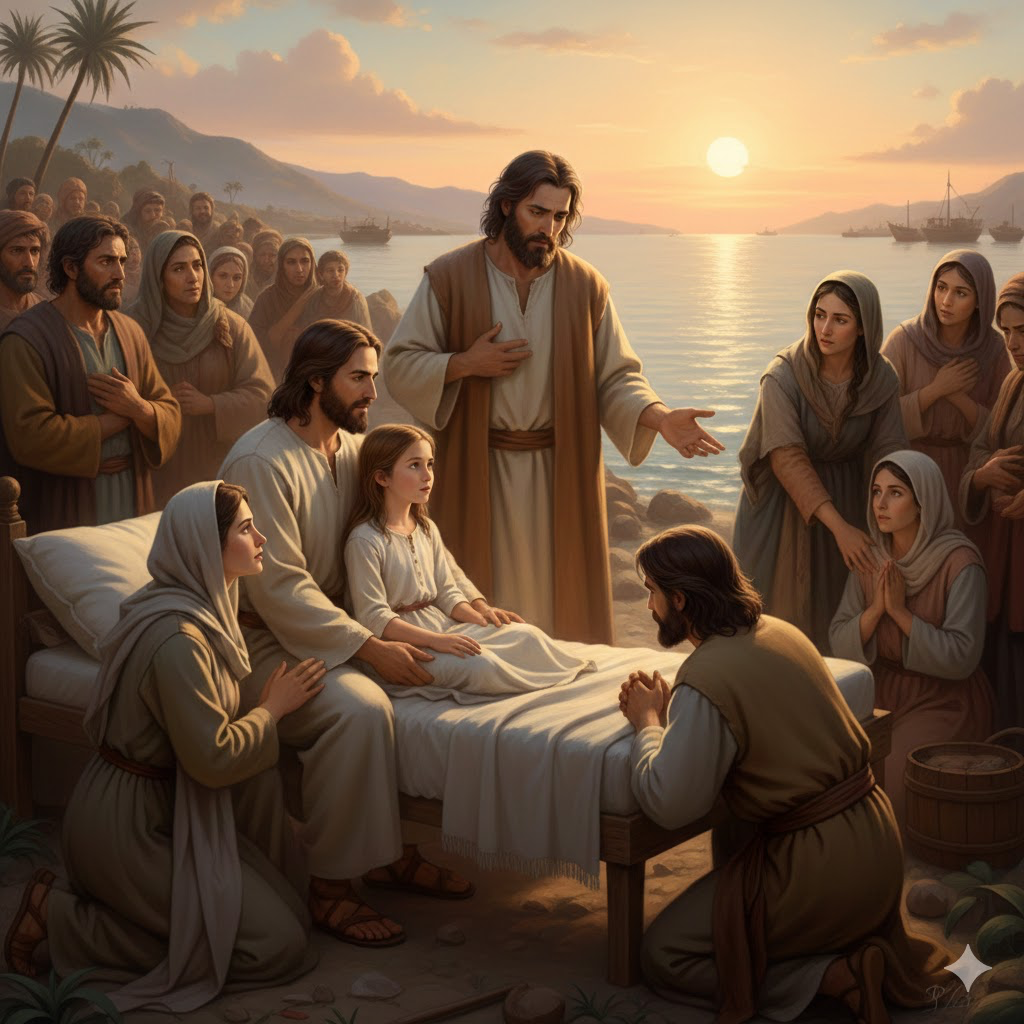
As a synagogue leader, Jairus appears to be a respected public figure. However, the man sets aside his status when he comes begging Jesus to cure his dying daughter. His social status does not come in the way of his faith. This is why he falls at the feet of Jesus and earnestly pleads with him to heal his daughter. Here, we must note that though Jairus has not explicitly said, ‘If I but ask Jesus, my daughter will live,’ his earnestness and approach reveal that Jesus was the last resort for him after trying every other means to get his daughter healed. Hence, in Jairus, we see a loving father who kneels in hope with radical trust in Jesus.
The woman with haemorrhages has been suffering for twelve long years. The fact that she was a nobody in that society is self-evident in the way she goes unnamed, unlike Jairus, the influential synagogue leader. Because she suffered from the issue of blood, she was ritually unclean too. Thus, we understand that the woman not only suffered from her health issue but also from social invisibility. Her anonymity in the crowd is clearly revealed in the way no one took notice of her, though there was a crowd pressing in on Jesus. But it is she who reveals her firm faith in Jesus by saying, ‘If I but touch his clothes, I shall be cured.’
What does Jesus do? How does Jesus respond to both?
In the case of Jairus, his daughter’s ill health was not the only problem but also the crowd’s discouragement. He had to cling to his faith in Jesus, even though the crowd persuaded him that ‘it was over for his daughter.’ It is also interesting to find that Jairus comes thinking that Jesus can heal the sick. But in the end, he finds that Jesus has power over death itself. We must note that it is not Jairus’ status but his faith that brings healing from Jesus.
With regard to the woman with haemorrhages, Jesus heals her in two ways. At first, she receives her physical healing just as she believed, saying, ‘If I but touch his clothes, I shall be cured.’ Secondly, Jesus also takes away her social invisibility and marginalization. By calling her ‘Daughter,’ Jesus ensures her social acceptance. And by acknowledging her faith in front of everyone, Jesus gives her the recognition that she was long denied.
Thus, the Markan text reveals Jesus as a healer in a unique sense. As such, we have three insights from the two intertwined healing accounts.
1. Faith is a relational virtue. Our healing flows from our personal encounter with Jesus.
2. Our faith in God reveals itself in radical trust. It inspires us to hope against all odds.
3. Healing from Jesus is not something partial but assures restoration of wholeness.
Let us pray that we may invoke Jesus’ name with the attitude of ‘If I but..’ as we discover in the examples of Jairus and the woman with haemorrhages.
Fr. Dhinakaran Savariyar
Discover more from Gospel Delights
Subscribe to get the latest posts sent to your email.
Good