
Tuesday, April 7, 2026
Acts 2: 36-41; Jn 20: 11-18
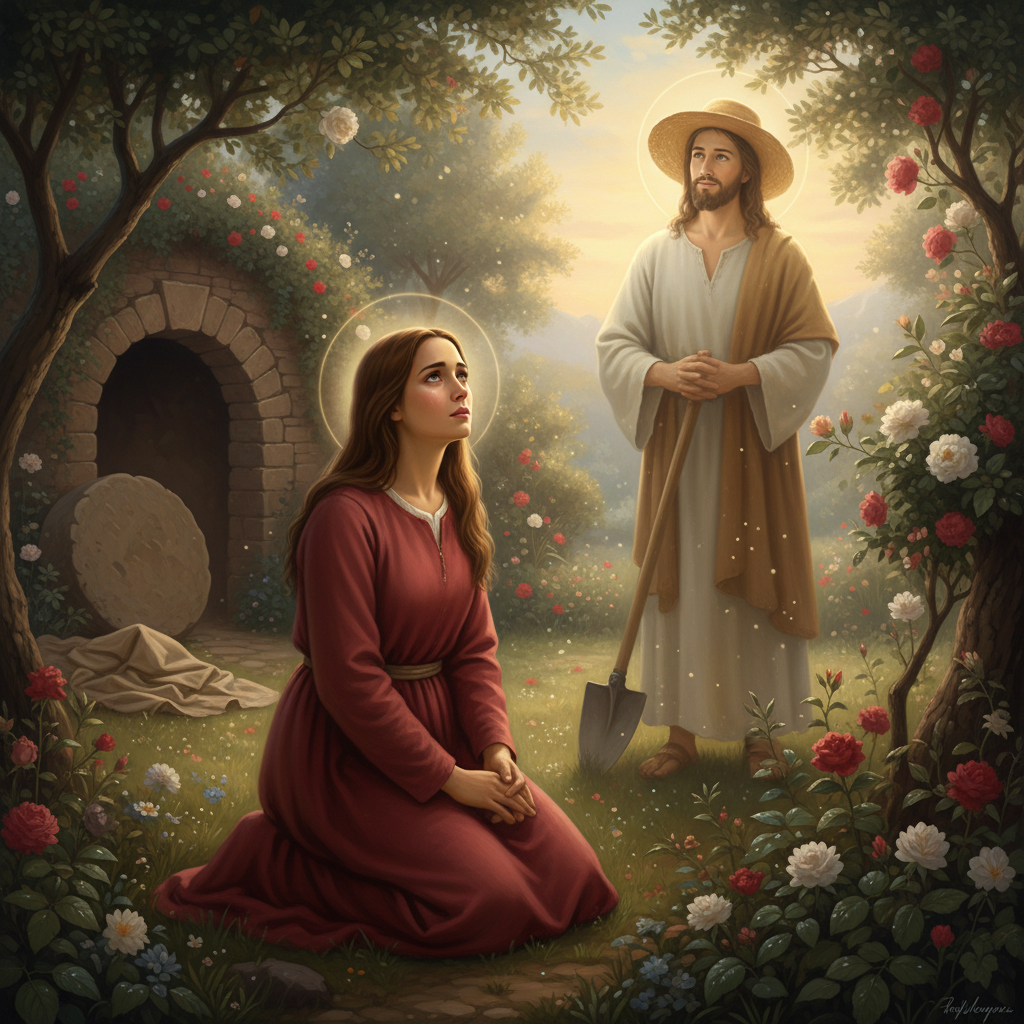
Today’s Gospel highlights Mary Magdalene’s (mis!)understanding of Jesus as a gardener.
Does Mary Magdalene’s misunderstanding of Jesus as a gardener teach any faith lesson?
Scholars believe that Mary Magdalene’s understanding of Jesus as a gardener is an example of Johannine irony. In their view, John meticulously prepares his readers in 19:41 by presenting, ‘At the place where Jesus was crucified, there was a garden, and in the garden a new tomb, in which no one had ever been laid.’ The verse helps our evaluation of Mary Magdalene’s ‘misunderstanding’ of Jesus as a gardener (20:15) in a theological light.
The Johannine irony unfolds in two ways. At first, Mary Magdalene supposes that the one she thought to be the gardener should know where Jesus was to be found. Secondly, by making a reference to the garden at Jesus’ burial place, John points to the garden (Eden) from where the world’s pain and sorrow began with the sin of Adam and Eve. Hence, through Mary Magdalene’s understanding of Jesus as a gardener, John explains that Jesus is the Gardener who produces life from the earth and is the Word of his Father, the Gardener of Eden. Put differently, the life that was lost in a garden is found again in it thanks to Jesus, the Gardener.
Other scholars believe that chapter 20 of John is unique for its Old Testament parallels. They put forward Jesus as the New Adam, tending to the garden. The risen Lord calls Mary Magdalene ‘woman’ at first before calling her by the name ‘Mary,’ just as Adam named Eve. The two angels guard the tomb as the cherubim guarded Eden. However, unlike the Genesis story, this new Eve does not disobey as Eve did but carries out Jesus’ command to break the Good News to his disciples. In light of these parallels, they hold that John 20 is Eden redeemed.
Capturing this theological profundity, the famous Dutch painter Rembrandt painted ‘Christ and St. Mary Magdalene at the Tomb’ in 1638. Most painters of his era chose the moment when Mary Magdalene reached out to touch the risen Lord that prompted him to say, ‘Noli me tangere’ – ‘Do not cling to me’ (Jn 20: 17) – to mean, ‘You have known me in the flesh; now you must know me by faith.’ However, Rembrandt differed from others by focusing on the intimacy rather than the grandeur of the resurrection in Mary Magdalene’s encounter with the risen Lord. He depicted Christ as a Gardener or ‘New Adam,’ thus opting for a tender portrayal of Jesus. In his rendering, Jesus is in the garb of a gardener, with a gardener’s hat, with a shovel in one hand, and carrying tools like a knife in his belt. Rembrandt’s Jesus is the Gardener set to work.
As if bearing a striking resemblance, Rembrandt’s work becomes a visual representation of the fourth century monk St. Macarius, the Egyptian, who explained the Incarnation and Crucifixion as God’s initiatives to restore human nature. He said, ‘When a farmer prepares to till the soil, he must put on clothing and use tools that are suitable. So Christ, our heavenly King, came to till the soil of mankind devastated by sin. He assumed a body, and using the Cross as his ploughshare, cultivated the barren soil of man.’
Rembrandt’s painting holds in balance the darkness of night and the promise of day to signify the movement from absence to presence, doubt to recognition, and grief to joy. Thus, the Dutch painter is noted for his profound meditation on the Easter story and not for its triumphant proclamation.
Mary Magdalene’s encounter with the risen Lord exudes hope that though we might reel under occasional setbacks in our spiritual journey – lost and wandering in a spiritual wilderness – as long as our search for Jesus is marked by the earnestness and patience of Mary Magdalene, even our misunderstanding might lead us to the recognition of the Lord.
Let us pray that we may stay patient like Mary Magdalene in our search for the Lord.
Fr. Dhinakaran Savariyar
Discover more from Gospel Delights
Subscribe to get the latest posts sent to your email.