
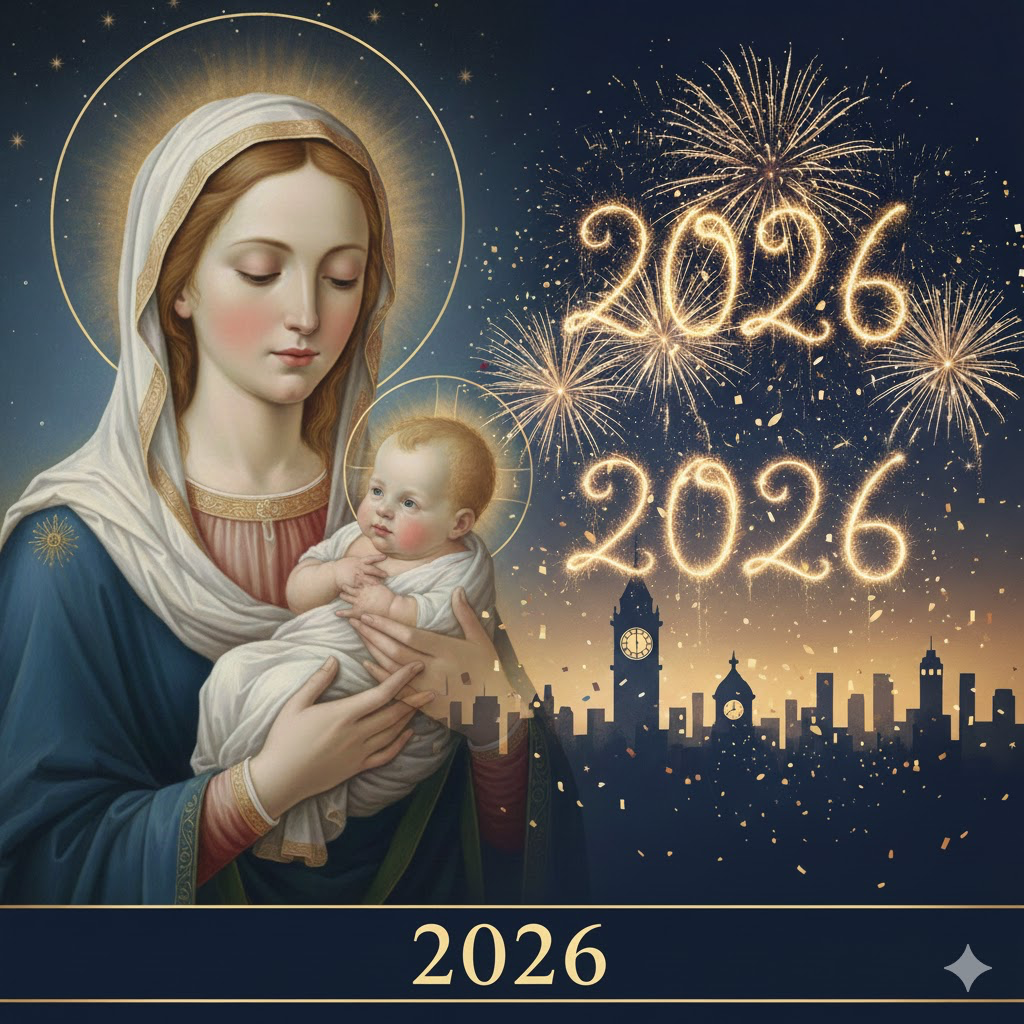
Thursday, January 1, 2026
Solemnity of Mary, the Holy Mother of God
Nm 6: 22-27; Gal 4:4-7; Lk 2:16-21
The Solemnity of Mary, Mother of God, invites us to contemplate new beginnings from the eyes of God.
It is quite surprising that when the world is lost in welcoming the first day of the new year, Catholics celebrate the solemnity of Mary, the Mother of God. Is it a feast that falls out of sync with what the world prepares to celebrate? In what way does the solemnity of Mary, Mother of God, guide the Catholic celebration of the new year? How can we look up and look ahead to the new year with Mary’s help?
The title ‘Mother of God’ (Theotokos) was formally declared at the Council of Ephesus in 431 AD. Addressing the Nestorian heresy, which denied the unity of Jesus’ divine and human natures, the dogma affirmed Mary as Theotokos, and the Church upheld Christ’s full divinity and humanity. The Mother of God bore Jesus Christ, who is both God and man.
By declaring this dogma, the Church also affirms that Mary as Theotokos reflects the profound mystery of the Incarnation. It is Mary’s fiat that allowed the Word to become flesh. Pope Saint John Paul II reflected on Mary’s divine motherhood while reaffirming the teachings of the Council of Ephesus: ‘Mary is the Mother of God (= Theotokos), since by the power of the Holy Spirit she conceived in her virginal womb and brought into the world Jesus Christ, the Son of God, who is one being with the Father’ (Redemptoris Mater, no. 4). Hence, celebrating Mary’s motherhood is also celebrating the fact that she became the first tabernacle.
Writing about the significance of Mary as the Mother of God, St. Cyril of Alexandria emphasized Mary’s title as Theotokos by affirming, ‘If anyone does not confess that Emmanuel is truly God and that the Holy Virgin is therefore the Mother of God, let him be anathema.’ St. Louis de Montfort proclaimed, ‘God the Father gathered all the waters together and called them the seas. He gathered all His graces together and called them Mary.’ The Marian Doctor St. Bernard of Clairvaux reflected on Mary’s role in the Incarnation by saying, ‘Through her, the world has been redeemed, and the human race restored to innocence.’
Thus, the solemnity of Mary, Mother of God, celebrates her faithfulness to God’s salvific plan by giving birth to the Son of God. While this celebration falls on New Year’s Day, we wonder if the solemnity adds any meaning to the birth of the New Year. As we can draw inspiring lessons from Mary’s life, I believe that the Holy Mother comes to our help to deepen our understanding of celebrating the New Year.
1. Mary is the source of new beginnings. With her ‘yes,’ she grandly inaugurated God’s plan of salvation through Jesus’ incarnation. With Christ’s incarnation, a new era is born for the world. Mary’s ‘yes’ not only cooperated with God’s will for the world but also resulted in the goodness of humanity. We frustrate the creational purpose if we fail to make use of our freedom to opt for God as Mary did.
2. Mary is the bridge builder between the divine and the human. By Christ’s incarnation, we celebrate the eternal union of heaven and earth. As the second reading highlights, God has sent his son, born of a woman under the law, so that we receive adoption as sons and daughters. We are now children of God, not slaves of sin and death. Mary invites us to build bridges between people so that whatever builds unity and solidarity is eventually reckoned as the work of God. Amid people who build walls, Christians are called to build bridges like Mary.
3. Mary saw through God’s eyes. Though Mary said ‘yes’ to God’s will, her life was not without confusions and anxieties. However, in those moments, Mary was not resigned to despair. Instead, just as we read in the Gospel today, Mary began to discern God’s will for her and humanity. In other words, she submitted herself to God in her moments of hardship. For Mary, thinking from God’s point of view was more important than anything. Learning from Mary, we must be determined to think from God’s perspective from this New Year.
4. Mary nurtured the early Church (Acts 1:14). Through her initiative, Mary teaches that discipleship is about making disciples of others. It is to take others to the God we believe in. In the way she assured her solidarity with the frightened band of disciples, Mary teaches that strengthening others to find meaning and purpose in their lives amounts to giving them God experience. We must learn from Mary the art of bringing others to God through our solidaristic love.
5. Mary’s life is a testament to the fact that we have been called to be a blessing to all. By her willingness to cooperate with God’s will, she became ‘blessed among women.’ However, she found joy in becoming a blessing to all. For instance, she was a blessing to Elizabeth, the host of Cana, and Jesus’ own disciples. Our mission is to reflect on our blessedness and share it with all others in a way that they will be inspired to seek after such a blessed state of life. The first reading, which features the priestly blessing, reminds us of God’s blessing to humanity through Christ, born of Mary. We must not forget that God’s blessing is due to humanity through us.
A New Year’s Day reflection on Mary, Mother of God, helps us discover that the attributes and virtues we find in Mary could very well form our New Year resolutions.
Let us pray that we may meaningfully begin this New Year with Mary’s heart and vision.
Fr. Dhinakaran Savariyar
Discover more from Gospel Delights
Subscribe to get the latest posts sent to your email.