
Thursday, April 2, 2026
Holy Thursday
Ex 12:1-8, 11-14; 1 Cor 11:23-26; Jn 13:1-15
Maundy Thursday invites us to remember Jesus’ service in love and its connection to priesthood and the Eucharist.
We know Jesus as one who upends our expectations. We are familiar with the Jesus who turns things upside down. To remember a few, Jesus says that ‘The last shall be first, and the first last’ (Mt 20:16); ‘It shall not be so among you; whoever wants to become great among you must be your servant’ (Mt 20:26); ‘Unless a kernel of wheat falls to the ground and dies, it remains only a single seed. But if it dies, it produces many seeds’ (Jn 12:24). When his disciples argued about who was the greatest, Jesus set a child in their midst to teach that true greatness lies in humility, service, and childlike trust rather than status (Mk 9:33-37). This is why the Kingdom that Jesus proclaimed about was an ‘upside-down Kingdom,’ which challenged and dismantled the world’s logic.
On Maundy Thursday, when we are called to remember and contemplate Jesus’ humility, we must not ignore the way in which our Lord connects the foot washing to priesthood and the Eucharist. For Jesus, the one who can empty oneself in service is the one who can give oneself in love.
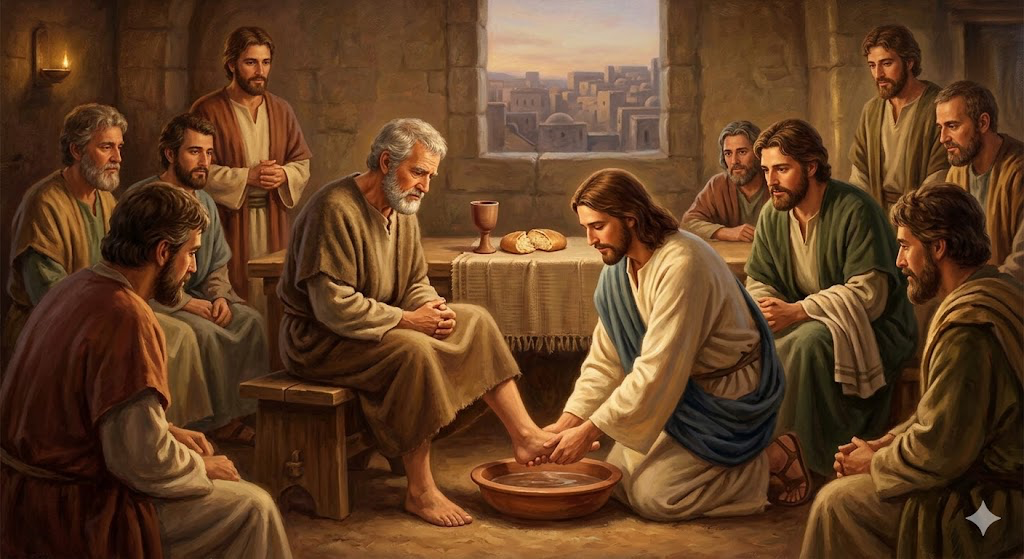
Maundy Thursday remembers Jesus washing the feet of his disciples. Emptying oneself in loving service is the very essence of priesthood. The very servantly act belongs to the ‘upside-down Kingdom’ that Jesus announced, only with the exception that it is no longer just spoken but enacted. Jesus, the ‘King of kings’ and ‘Lord of lords,’ rises from the table, ties a towel around his waist, pours water into a basin, and kneels to wash the feet of his disciples. For those who experienced foot washing as a common form of hospitality, usually coming from a slave or servant of the house where one entered as a guest, the same act coming from Jesus meant something more profound. If the King washed the feet of his subjects and if the Master washed the feet of his disciples, the implication was more than what the eye just met.
Jesus’ foot washing is more than merely symbolic. It determines the very core of Christian discipleship because this is one final and embodied lesson from the Lord to his disciples. When Jesus knew that his hour had come, he stooped to wash the feet of his disciples as if to tell them that all his teachings were exemplified in what he just did in a servantly act. We are made to understand that everything that Jesus ever proclaimed was contained in this final act. In the way Jesus’ foot washing reinforced all his teachings, we famously believe that the Last Supper is also the Last Lesson.
If we observe closely, when Jesus washes the feet of his disciples, he does not do it selectively. He washes the feet of Judas, who will betray him; he washes the feet of Peter, who will deny him thrice; he washes the feet of those who will abandon him when he needs them the most. Thus, Jesus’ powerful act proves that love cannot be selective. It is unconditional and universal in scope. Furthermore, Jesus ascertains by asking, ‘Do you realize what I have done for you?…If I, therefore, the master and teacher, have washed your feet, you ought to wash one another’s feet…I have given you a model to follow, so that as I have done for you, you should also do.’ By these words, Jesus mandates that his example does not merely call for admiration but for imitation. Remembering Jesus means not just recreating what he did but also living out what it points to or signifies.
Peter objects to Jesus’ act. Rightly so, because Jesus is his master. However, Jesus warns him that he can have no share with him unless he lets him wash his feet. What does Jesus mean here? Peter’s objection signifies his own understanding of society’s power structure: the Lord cannot serve and the master cannot minister. By objecting to Jesus’ washing of his feet, Peter unknowingly holds on to the pyramid of power that Jesus intends to subvert. This is why Jesus has to be so stern to tell him that unless you have your feet washed by me, you will have no role with me.
By taking the place of the least and the lowliest, Jesus declares that in his Kingdom, there is no hierarchical or pyramidal understanding of power. In Jesus’ Kingdom, there is no class or caste. In his Kingdom, every person is valued, every person is honored, and every person is loved. In his body, the Church, every person’s life and presence are significant. Hence, to follow Jesus is to become someone like him who will respect the other person’s dignity, who will assume service without pride or ego, and who will continue Jesus’ legacy of becoming a servant in love.
In a more beautiful way, Jesus ties the foot washing to the priesthood and more specially, to the Eucharist. Thus, the one who washes their feet is also the one who says, ‘This is my body and this is my blood.’ The one who washes their feet is the one who gives his life for others. Hence, the Eucharistic meal is not only about receiving the body and blood of Christ but also about being profoundly transformed by them. As we participate in the Eucharist, we bind ourselves with the will and vision of Christ. Hence, to walk to the Eucharistic table means to say, ‘I will reject the temptation of power; I will uphold the dignity of the oppressed; I will give myself in love to others.’ Indeed, there is or can be no participation in Christ without first learning his humility and sacrifice.
Now, how can we remember Jesus in our everyday lives?
1. Remembering Jesus means not participating in or building systems of power and privilege. We cannot radiate Christ if we cannot imitate his poverty, humility, and service. The world must witness the fact that the Christian revolution begins with living out Christ’s humility.
2. Remembering Jesus is reflecting his authority, which is more moral and spiritual. It is an authority from below. It begins from lowering oneself like Jesus and making oneself weak and vulnerable in love.
3. Remembering Jesus means recreating the manner of his life. While Jesus’ foot washing is a new way of being human for others, this is probably the only way of being the disciples of Christ for Christians.
Let us pray that we remember Jesus by serving others in love.
Fr. Dhinakaran Savariyar
Discover more from Gospel Delights
Subscribe to get the latest posts sent to your email.