
Thursday, March 28, 2024
Holy Thursday
Ex 12:1-8,11-14; 1 Cor 11:23-26; Jn 13:1-15
The Holy Thursday revolves around three important themes: the institution of the Holy Eucharist, the institution of the sacrament of ministerial priesthood, and fraternal charity. Jesus founds all three on the servant leadership, for which he shows an example through his foot washing.
Jesus’ celebration of the feast of Passover is more insightful. As the Gospel describes, his hour of departure has come. Jesus is living through his final moments. Anyone might expect that a famous preacher like him would render the scene more evocative through his parting message.
Jesus surely wanted to leave behind his message. He surely wanted the world to remember him. He surely wanted to be present with his followers even after his departure. But he did not resort to conventional ways to pass on his memory. Instead, he performed highly symbolic acts.
My Body, My Blood: In the second reading, Paul remembers what Jesus did by way of offering his body and blood, which we celebrate as the sacrament of the Eucharist. He wanted the world to remember him but through his loving sacrifice. Jesus gave his own self, not an external object that would trigger our memory of him.
Do This in Remembrance of Me: He instituted the sacrament of ministerial priesthood through this command. The ministerial priesthood honors the Lord when it helps the Eucharistic community to break the bread and drink the cup as one congregation in his memory.
Love Commandment: Jesus’ way of inspiring others was chiefly through example. It is by drawing inspiration from the selfless love of Jesus that we can adequately love others. ‘Love one another as I have loved you’ (Jn 13:34) are not mere words. The statement summarizes the very life of Jesus and the invitation we have received to follow him.
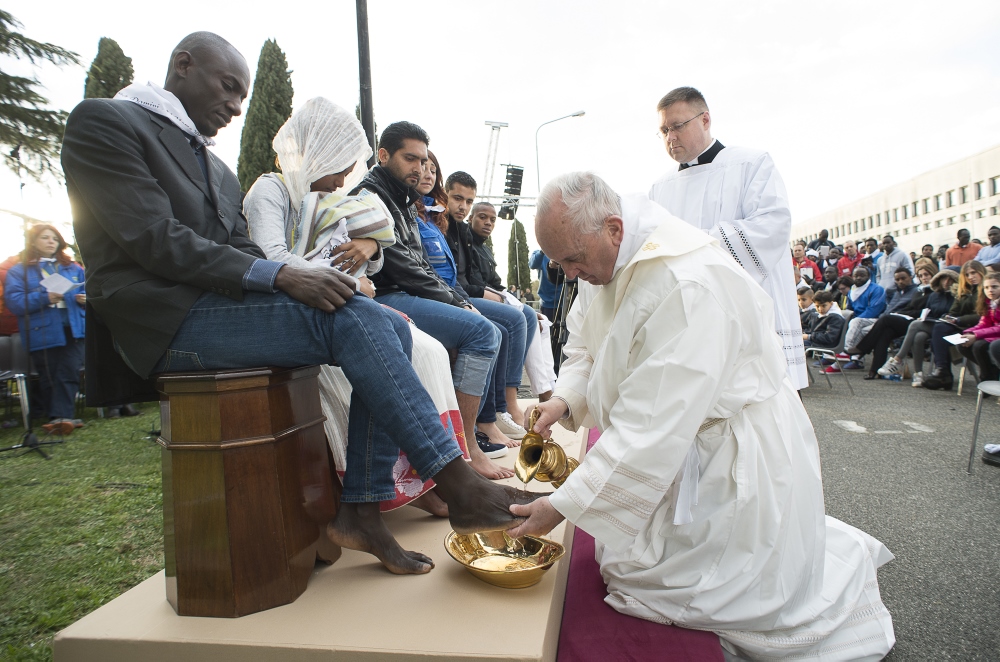
Foot-Washing: The most dramatic moment of today’s liturgy is the act of foot-washing that Jesus gives as an example. Interestingly, it comes as a summation of all three.
The sacrificing of Jesus’ self is represented in this act, which was only proper for a slave. Before his physical dying on the cross, Jesus demonstrates the act of dying to oneself in order to thrive in fraternal charity.
If there is one best way to remember Jesus and his life, it is through his model of servant leadership. We cannot remember Jesus apart from this noble expression of fraternal service.
Jesus’ invitation to follow him is not without an example. In this sense, following Jesus is as simple as looking up to him to walk behind him. The phrase ‘As I have loved you’ demonstrates the sincerity of Jesus’ love, which also gives him the authority to say, ‘Love others as I have loved you.’
Hence, the self-emptying expression of Jesus did not just happen on the cross but before he walked toward it. In that sense, the word ‘self-emptying’ summarizes both his life and death.
When Jesus said, ‘Do this in my memory,’ he made ‘remembering’ so radical through all these.
How prepared are we to remember Jesus?
Fr. Dhinakaran Savariyar
Discover more from Gospel Delights
Subscribe to get the latest posts sent to your email.