
Sunday, November 12, 2023
Thirty-Second Sunday in Ordinary Time
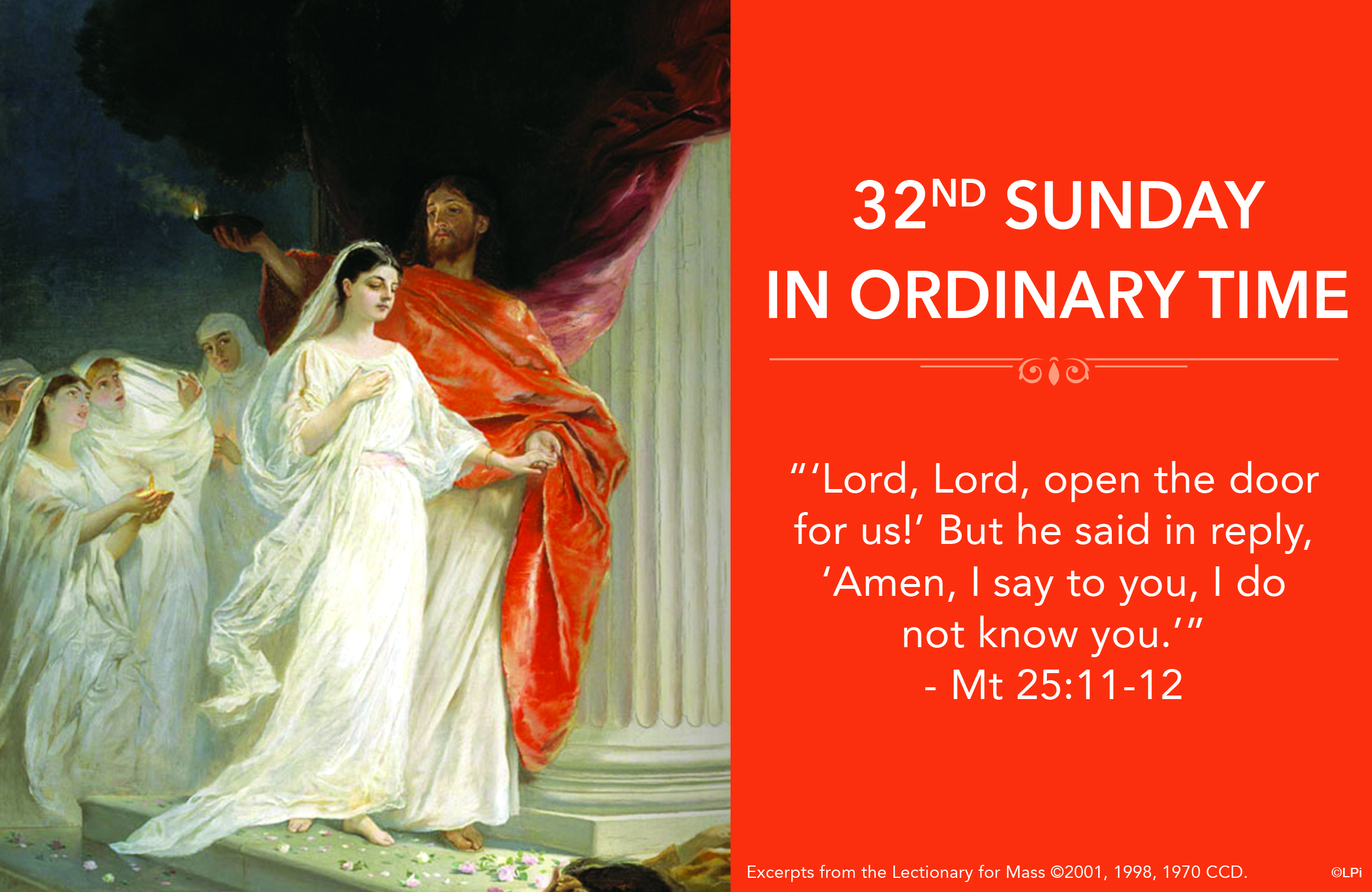
Wis 6:12-16; 1 Thes 4:13-18; Mt 25:1-13
The liturgical year closes shortly. Ahead of Advent, this Sunday instructs us on watchfulness.
The theme of watchfulness is found in all three readings.
The first reading talks of wisdom, whose pursuit requires profound love and seeking. It reveals itself according to the measure of one’s search, and the constant seeking is rewarded when those who pursue it stay sincere, watchful, and prudent. Translated to Christian life, our love for God and imitation of Jesus will be fruitful when our love is sincere and watchful. Staying attentive in our spiritual journey is significant so that we can find God manifested in the ordinary realities of daily life. Spiritual wisdom in Christian life is a gift for those whose search is characterized by sincerity, preparedness, and watchfulness.
In the second reading, Paul wants the Thessalonians to be watchful regarding their knowledge of the resurrection so that they will not be distracted by anything that contradicts the truth. For this reason, he talks of grief. Paul tells the Thessalonians that, as Christians, their grieving has to have an elevated character compared to the rest. Others mourn for their loved ones because death is a finality for them. Whereas for Christians, who have been promised resurrection through the resurrection of Christ, death is a mere passing while resurrection will be eternal glory. Paul wants the Thessalonians to stay alert to the fact of the resurrection and not be distracted by any false knowledge.
In the Gospel, Jesus talks of watchfulness through the parable of the ten virgins. There are some commonalities and differences between the wise and the foolish. Although both the foolish and the wise look forward to the arrival of the bridegroom, only the wise feel the need to be prepared. They leave nothing to chance. Their eagerness is symbolized through their meticulosity.
On the contrary, the foolish ones are neither prepared nor patient to await the coming of the bridegroom. It is their lack of patience and eagerness that renders them dull. The only difference is that the wise feel drowsy from their tiredness, having made their preparations beforehand, but the foolish feel drowsy from their laziness or lack of thought, which is already seen in their failure to prepare. They are not bothered enough to welcome the bridegroom with adequate readiness. If meeting with the bridegroom is what they have waited for, how absurd is it to let the opportunity slip through their fingers just because they would not take care to be prepared? The foolish virgins remind us that our efforts should match the size of our dreams.
Maybe, for our clarification, we should briefly reflect on the refusal of the wise virgins to share their oil with the foolish. It is good to keep in mind that the wise ones did not mean to be uncharitable. Rather, they do not want to spoil the moment of their meeting with the groom (which they awaited eagerly with much preparation) due to some inadequacy that the foolish ones could have avoided with only a little thought for preparation.
Jesus extends this parable as a metaphor for Christian life. As regards life, we don’t know what to expect along the way. But we certainly have the time and resources to keep ourselves better prepared for what is to come. The time for preparation is the same for everyone. It is how we make use of it that makes us different.
Let us pray for the ability to stay watchful so that we don’t let the wisdom of following Jesus pass by us unnoticed!
Fr. Dhinakaran Savariyar
Discover more from Gospel Delights
Subscribe to get the latest posts sent to your email.