
Thursday, August 1, 2024
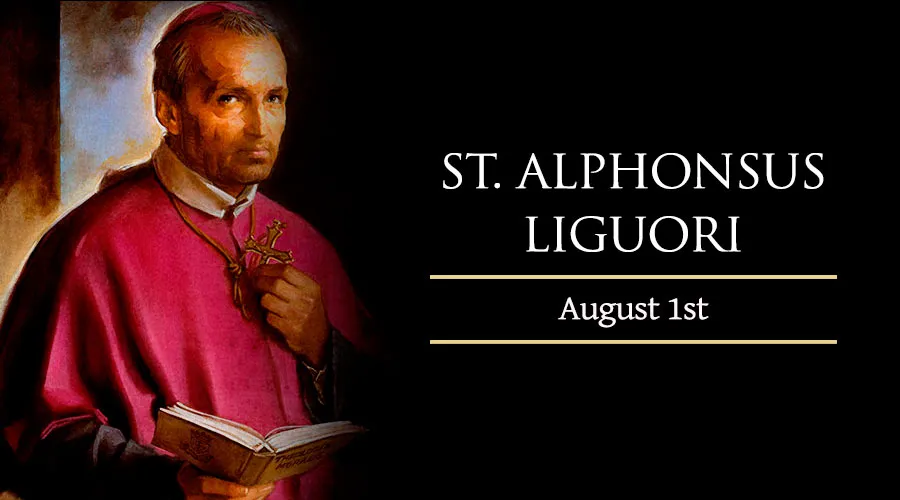
Feast of St. Alphonsus Liguori
Jer 18:1-6, Mt 13:47-53
Today, we celebrate the feast of St. Alphonsus Liguori.
The founder of the Redemptorists Congregation was at the peak of his profession as a lawyer at the age of 20.
For eight years, Alphonsus never lost a case he defended. But when he lost a case for the first time, he quit the profession, never to return thereafter.
The humiliating defeat helped him realize that, away from God, it would be impossible to satisfy the deepest longings of our hearts.
Alphonsus, who earned his doctorate in both civil law and canon law by the time he was sixteen, turned his smartness into a pastoral genius to undertake creative evangelization.
Ahead of time, St. Alphonsus envisaged lay empowerment. He wanted the laity to lead the Church. Liguori showed how a radical love for God can bloom into a pioneering mission.
He set up a confraternity in the name of Cappelle Serotine (Evening Chapels). Designed exclusively to reach out to the poor working class, Liguori’s evening chapels employed what modern sociologists call a ‘bottom-up’ approach.
Liguori’s ingenuity as a missionary lay in his choice of place for his mission. He sought his ‘chapel’ among the lazarri – the Lazaruses of that society, which consisted mostly of homeless beggars.
Another beauty of the evening chapels is that the leadership of running them was entrusted to the laity rather than to the priests.
A mission that was conceived for lay leadership with priests as mere ‘go-betweens’ was no ordinary feat, especially within the fortress of the institutional Church.
A biographer of Liguori Terrence Moran described his mission in the following words: ‘[Alphonsus] He, with other priest friends, established the cappelle serotine or evening chapels in which laity would meet in the evening after the day’s work for prayer, instruction in spirituality, and mutual support in virtue. While Alphonsus and other priests served as resource people, the evening chapels were directed by the laity, both men and women. Their membership included the Lazzaroni, the numerous street people of Naples, many of whom reached high levels of sanctity.’
Another biographer, Theodule Rey-Mermet reports an interesting conversation between a barber and a young man. The young customer is edified by the leadership of the barber at evening chapel meetings.
Rey-Mermut writes: ‘Alphonsus did not come that evening, but the master of the house [the barber] took over the evangelization of the group and joined them in prayer. Our young man’s [the young customer] heart was touched and he became an active member of the group; filled with grace, he began coming to his barber not just to be groomed but to increase in holiness.’
Former Pope Benedict XVI praised the pastoral vision of St. Alphonsus Liguori: ‘Even though the social and religious context of the time of St. Alphonsus was very different from our own, the ‘evening chapels’ appear as a model of missionary action from which we may draw inspiration today too, for a ‘new evangelization,’ particularly of the poorest people, and for building a more just, fraternal, and supportive coexistence. Priests were entrusted with a task of spiritual ministry, while well-trained lay people could be effective Christian animators, an authentic Gospel leaven in the midst of society.’
Ahead of time, Liguori gave us the content of ‘new evangelization’ besides demonstrating what it means to empower the laity.
His theological wisdom and missionary zeal to show ‘theology in action’ by turning the laity into agents of new evangelization are unparalleled.
The patron saint of moral theologians always inspires us to get inventive about God’s mission!
Fr. Dhinakaran Savariyar
Discover more from Gospel Delights
Subscribe to get the latest posts sent to your email.