
Saturday, June 29, 2024
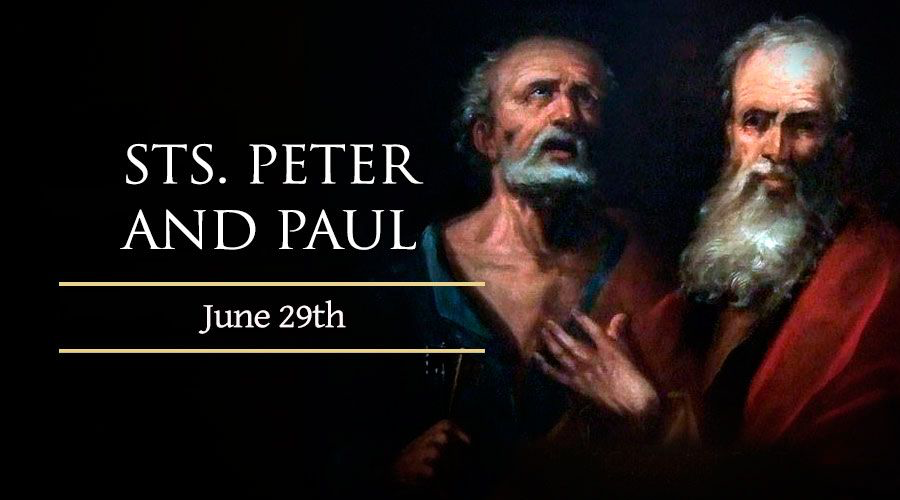
Solemnity of Saints Peter and Paul
Acts 3:1-10; Gal 1:11-20; Jn 21:15-19
The feast of Saints Peter and Paul invites us to reflect on what we can bring out to enrich the life of the Church.
The two great apostles were first-century Jewish men, seriously devoted to the Law, the Prophets, and the Jewish religion.
Their characteristic traits made them dedicated apostles of Jesus Christ, and they both died for their faith in Rome under Emperor Nero.
Though Peter and Paul became the foundational figures of the Catholic Church, their roles in the early Church were different in terms of their ecclesiastical office and charism.
Though Peter was given a unique position of governing authority by Christ, he readily acknowledged ‘the wisdom given’ to St. Paul (2 Pet 3:15-16).
The intellectually gifted Paul spent time learning from the head apostle himself after his dramatic conversion (Gal 1:18).
Recalling their significance to the life of the Church, Pope Benedict XVI said, ‘Christian tradition has always considered Saint Peter and Saint Paul to be inseparable: indeed, together, they represent the whole Gospel of Christ.’
The foundational figures of Catholicism teach us what is NOT important to become faithful workers in the vineyard of the Lord.
Origin: Both Peter and Paul were apostles of humble origins. But that could not prevent them from becoming the faithful apostles of Christ. Peter, the fisherman, became the head of the Church and proved his loyalty to the Gospel by sacrificing his life. Paul, who was a soldier, became a soldier of Christ by not only evangelizing the Gospel of Christ but also by willingly dying for it. After a careful study of the lives of Peter and Paul, we realize that regardless of who we are, our ordinariness can be even the stepping stone for our extraordinary vocations.
Past: Both Peter and Paul shared a troublesome past when it came to their discipleship. Though Peter was made the head of the Church, he denied the Lord three times and could not get rid of that guilt easily. Worse still, Paul was a proclaimed enemy of Christ and Christians and, as such, a known persecutor of the early Church. He wanted to cut off any tongue that pronounced the name of Jesus and any hand that would make the sign of the cross. However, God’s grace turned such radical hatred into a radical love for Christ, and the rest is history. Our controversial past cannot be a stumbling block to carving a glorious future for Christ.
Ideology: Both Peter and Paul had very different ideologies. Chapter 2 of Galatians gives us a glimpse of the difference between the two on the issue of sharing the table. Paul says that, while in Antioch, Peter ate with Gentiles. But, when delegates sent by James arrived, Peter distanced himself from the Gentiles, fearing James’ delegates. Upon seeing that behavior, Paul publicly reprehended Peter. Though this might have been true, what we cannot overlook is that such ideological differences never stopped them from evolving into the ideal apostles that Christ desired. Learning from their mistakes, Peter and Paul laid a firm foundation for the universal Church.
The Church needed Peter, who represents her stability, and Paul, who represents the mission of evangelization.
Like Peter and Paul, Jesus needs every single one of us to proclaim and defend his Gospel.
Fr. Dhinakaran Savariyar
Discover more from Gospel Delights
Subscribe to get the latest posts sent to your email.