
Friday, August 28, 2026
Feast of St. Augustine
1 Cor 1: 17-25; Mt 25: 1-13
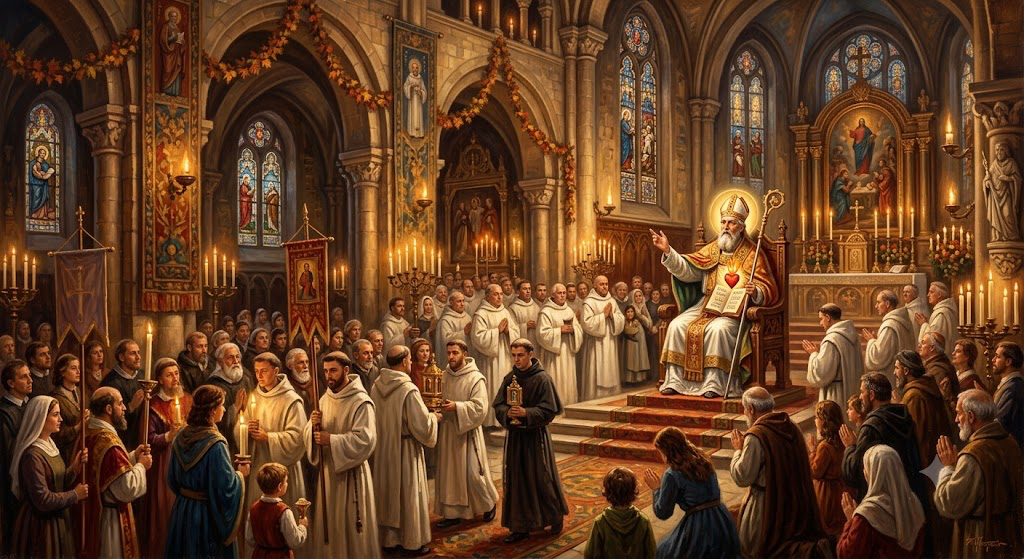
The Feast of St. Augustine highlights what real conversion looks like in a person.
Confessions, the spiritual autobiography by St. Augustine, underlines the profound manner in which his return to God took place. As a converted man, St. Augustine subjected himself to rigorous retrospection, and this is why his honest confessions have become a spiritual guide for those who desire a spiritual homecoming.
Reading St. Augustine’s life, one can find that he was reflective at every stage in his life so that he guarded himself against those sins that characterized his past life. We may reflect on three points regarding the conversion of St. Augustine.
Recalling his mother’s unceasing tears for him, St. Augustine writes that his mother, St. Monica, wept for him ‘more than mothers weep when lamenting their dead children.’ He writes on his mother’s love thus: ‘I cannot sufficiently express the love she had for me, nor how she travailed for me in the spirit with a far keener anguish than when she bore me in the flesh.’ What is more, St. Augustine could faithfully remember the troubles her mother took to instruct him in faith so that, later in his life, he understood that it was God who intervened in the person of his mother. Commenting on how God spoke to him through his mother, St. Augustine wrote, ‘Then whose words were they but yours which you were chanting in my ears through my mother, your faithful servant?’ Indeed, St. Augustine became a converted man, but through his mother’s tireless prayers and instructions.
Secondly, St. Augustine’s Confessions is widely regarded as a spiritual classic because it captures the struggles of someone who wants to return to God, though he feels the pulling power of worldly desires. And St. Augustine’s candid examination of his past sinful life encourages the readers to believe that it is never too late to change and become the kind of person we want to be. Though St. Augustine wished to transform his life, it did not happen the way he wanted it. He was ‘impatient of the delay’ because he was still ‘a slave to lust.’ This is why, in his desperation, St. Augustine felt that he lost his ability to distinguish between physical desire and actual love. Thus, in writing his memoir, St. Augustine did not feel the need to whitewash his mistakes or pretend that he never committed anything wrong. This courage and his reliance on God helped St. Augustine overcome his vices eventually.
Thirdly, St. Augustine inspires his readers by turning himself into an example of a defective past. For this reason, he never shied away from using his life as a living reflection of The Prodigal Son. In the prodigal son’s journey away from his loving Father, St. Augustine saw his own turning away from God. Thus, the ‘far country’ became an internal state for St. Augustine. Here, St. Augustine also discusses spiritual disintegration. He described sin as spending the ‘inheritance’ of God’s gifts on worldly desires, which causes the soul to scatter and ‘go to pieces.’ For St. Augustine, the prodigal son’s starvation in the pigsty reflects a spiritual emptiness in humans. Just like the prodigal son, St. Augustine felt that he left home and chased lust and false philosophies like Manichaeism. Later on, when he looked at his inner emptiness, St. Augustine profoundly felt the need to return to God, only to experience God’s loving embrace. Thus, St. Augustine inspires the conversion of many by turning his own life into a textbook of waywardness and the irruption of God’s unconditional love and mercy.
Reading St. Augustine’s Confessions, we discover that his saintliness is not in his waywardness but in his honest reflection on his waywardness with a strong determination to return to God in whom the restless hearts find their true rest.
Let us pray that we may be inspired by St. Augustine’s life to reflect on God’s abundant mercy.
Fr. Dhinakaran Savariyar
Discover more from Gospel Delights
Subscribe to get the latest posts sent to your email.