
Sunday, August 2, 2026
Eighteenth Sunday in Ordinary Time
Is 55: 1-3; Rom 8: 35, 37-39; Mt 14: 13-21
The eighteenth Sunday invites us to cherish God’s abundant love and give the same to others.
The three readings lead us to a profound reflection on the theme.
The first reading highlights God’s generous invitation to those who are thirsty, weary, and broken. The four important verbs from the first reading are: ‘Come,’ ‘Drink,’ ‘Eat,’ and ‘Live.’ At first, the invitation is given to those who are not only thirsty but also broke, as they cannot afford to pay for what they eat or drink. The words of Isaiah suggest that it is these kinds of people that God is after. Here, we must note that the invitation is also meant for those who have money but live in frustration. Hence, God’s invitation is meant to give them comfort and satisfaction. To this end, the three things – water, wine, and milk offered by God – are meant to refresh and strengthen those who have them. In the end, God urges His people to listen and take heed. Here, God wants His people to distinguish between the advertisements for this world and the invitation to heaven. We are to ask ourselves, ‘What do we choose between the two?’
The second reading carries a powerful reminder that no problem or difficulty can change Christ’s love for us. In this sense, God’s love is invincible for a believer. Paul mentions seven types of hardship: tribulation, distress, persecution, famine, nakedness, peril, and the sword. Having listed all the seven difficulties, Paul reminds his audience that the promise is not that Christians will avoid these sufferings but that our sufferings cannot alter Christ’s love for us. Further, Paul wants us to note that these seven difficulties are not meant to despair the believers but must instead convince them about God’s unchanging love for them. For this reason, Paul concludes the passage with the greatest affirmation that absolutely nothing will separate us from the ‘love of God in Christ Jesus’: existence (neither death nor life), spiritual forces (neither angels nor principalities/powers), time (neither things present nor things to come), and space (neither height, depth, nor any other created thing). Paul wishes that when Christ’s love for us is thus absolute, our option for him must reflect the same radicality.
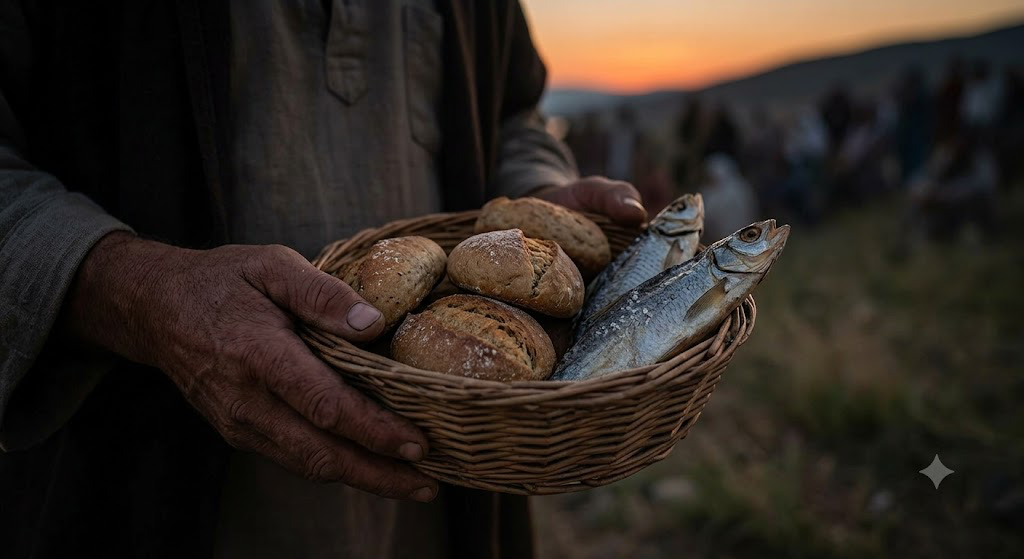
The Gospel text on Jesus feeding the five thousand is an example of Jesus’ radical compassion, which he shows even while grieving the death of his cousin, John the Baptist. Despite his desire for a time away, his compassion prioritizes the needs of those who follow him, and therefore, he starts his healing and teaching mission. When his disciples highlight the impossibility of feeding such a large crowd, Jesus directs them to ‘give them some food’ themselves. Thus, Jesus turns the obvious limitation into a miracle for them to believe. Here, as he performs the miracle of multiplication of loaves, he also invites his disciples to participate in it. Jesus makes his disciples distribute the loaves. Further, Jesus demonstrates that God often works through what we offer. Thus, the ‘five loaves and two fish’ are multiplied to meet the needs of an immense crowd. Finally, the twelve leftover baskets symbolize not only the abundance but also the total satisfaction of the crowd that followed Jesus. It mimics the comfort and satisfaction that God promises His people in the first reading.
The three readings inspire us with powerful insights into life.
1. Only God can satisfy the deepest human hunger. While worldly prosperity and achievements seem to offer satisfaction, they do not culminate in peace in the absence of God. Love of God and, by extension, love of neighbors is the best way to conquer our inner emptiness.
2. The readings invite us to discover the permanence of God’s love in our lives. The list of difficulties that Paul highlights is not some theoretical assertion. Paul went through them all and experienced God’s abiding presence and love during those moments. Now, he urges his audience to trust in the fact that God’s unconditional love will never abandon us.
3. While Jesus performs the multiplication of loaves, He wants us to supply the resources – the five loaves and two fish. It is not that God cannot create anything out of nothing but that He wants us to participate in miracles through our small acts of generosity.
Let us pray that we may cherish God’s abundant love and disseminate the same to others.
Fr. Dhinakaran Savariyar
Discover more from Gospel Delights
Subscribe to get the latest posts sent to your email.
Amen