
Sunday, April 26, 2026
Fourth Sunday of Easter
Acts 2: 14a, 36-41; 1 Pet 2: 20b-25; Jn 10: 1-10
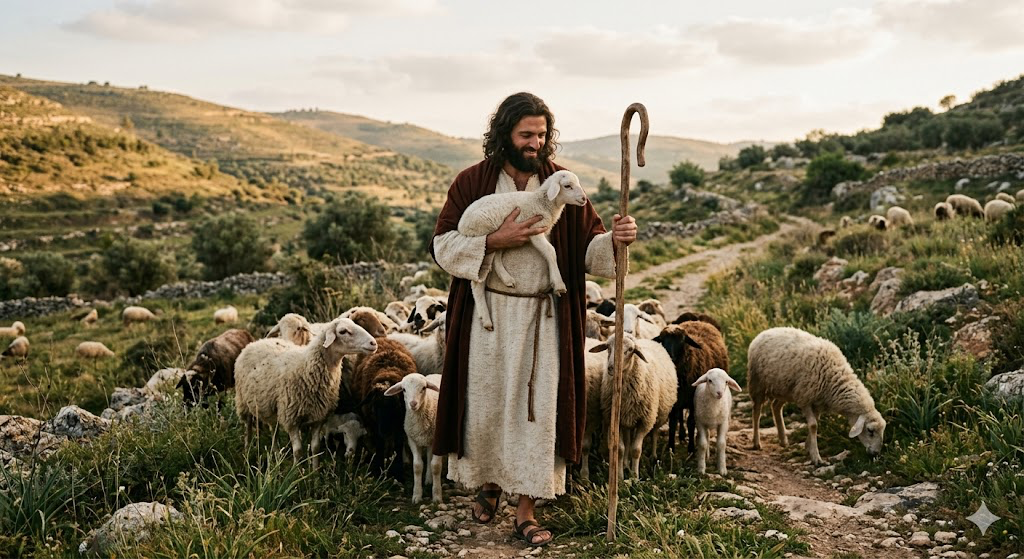
The fourth Sunday of Easter, known as the Good Shepherd Sunday, invites us not just to reflect on the powerful image of Jesus Christ, the Good Shepherd, but also on our role as the good sheep that faithfully follow him.
It is hard to deny the fact that the image of Jesus Christ, the Good Shepherd, is legendary to the extent that many across the globe, regardless of any religious affiliation, are fond of it. A reflection on leadership is not adequately done without invoking the image of Jesus Christ, the Good Shepherd. Psalm 23 is equally famous for this reason.
The image of the Good Shepherd offers us consolation as we find ourselves under the care of Jesus Christ, the Good Shepherd. The words of the psalmist who sings, ‘The Lord is my shepherd; there is nothing I shall want,’ help us realize that following the Good Shepherd is as easy and comforting as walking in the park.
While all these are true, the fourth Sunday of Easter helps us realize that the image of the Good Shepherd is incomplete without the reflection on the other side of the relationship: the sheep. The Good Shepherd has done his part fully and completely. His love has withheld nothing. His commitment to his sheep is total. His sacrifice has given us life in abundance. Thus, while we take comfort in the truth that the Lord is our Good Shepherd, the call to be the good sheep is unfortunately an ignored or overlooked fact.
Hence, the readings of today invite our reflection on the invitation to be the good sheep.
The first reading shows how willful listening leads to conversion. When Peter explains to the gathering about its culpability in crucifying Jesus, the sorrowful crowd, ‘cut to the heart,’ asks, ‘What are we to do now?’ Their question reveals that they did not merely listen to Peter’s words but allowed themselves to be challenged and transformed by them. Their question highlights their willingness to set things right. Their openness to the words of Peter leads to their atonement. This is when Peter wants them to confirm their contrition of hearts through the baptism of forgiveness and reconciliation. In sum, the first reading invites us to be willing enough to ask, as the good sheep, ‘What are we to do now?’
The second reading highlights ‘returning’ to Jesus as the sign of the good sheep. Peter reminds us of the harsh truth that, at times, ‘we go astray like sheep.’ While this is not an accusation, Peter’s words point to the recognition of human frailty. This is why Peter does not end his teaching on a negative note. Instead, he highlights what is more pleasing to the Lord by saying that ‘You have now returned to the shepherd and guardian of your souls.’ Peter’s words remind us that being the good sheep is about making a bold comeback to the Lord. We must note that Peter’s words underline the virtue of humility, which enables our conversion and facilitates our return to the Lord.
The Gospel catalogues the wonderful qualities of the Good Shepherd that inspire us to follow him willingly. The Good Shepherd enters through the gate, recognizes his sheep, and calls them by name. Above all, he goes ahead of them to ensure their safe passage. It reminds us of the old adage that goes, ‘The Shepherd knows the way, shows the way, and goes the way.’ By his goodness and qualities, the Good Shepherd makes the following easy and effortless for his sheep.
While the Gospel portrayal of Jesus, the Good Shepherd, is an inspirational image, the text reminds us of our responsibility to be the good sheep as well. Hence, following Jesus, the Good Shepherd, makes a moral claim on us. We cannot just stop admiring Jesus without following him intentionally. In this regard, Good Shepherd Sunday is both a comfort and a challenge. It assures us of the Good Shepherd’s unfailing care for us. It does demand that we rise up to our identity as the good sheep that are faithful, attentive, and responsible.
The three readings of the day help us with powerful insights to ponder.
1. Oftentimes, we stop romanticizing the image of the Good Shepherd without adequately reflecting on its call to a lived commitment. Hence, being the good sheep means moving beyond devotional sentiments or feelings and internalizing the virtues that the Good Shepherd represents.
2. Being the good sheep means committing ourselves to an active and intentional following of the Good Shepherd. In other words, it is a call to transcend passivity and align our wills with Jesus’ voice and direction. Yet, we are not alone in this task. We can well do it with grace and strength coming from the Good Shepherd himself.
3. Being the good sheep means becoming the replica or miniature of the Good Shepherd. In our own small ways, we are invited to embody the compassion, patience, sacrifice, and care of the Good Shepherd. Though perfection will still evade our grasp, a life shaped by the Good Shepherd’s example is nothing short of greatness and nobility.
Let us pray for the grace to be the good sheep that will follow the Good Shepherd in all earnestness.
Fr. Dhinakaran Savariyar
Discover more from Gospel Delights
Subscribe to get the latest posts sent to your email.