
Sunday, June 7, 2026
The Solemnity of the Most Holy Body and Blood of Christ
Deut 8: 2-3, 14b-16a; 1 Cor 10: 16-17; Jn 6: 51-58
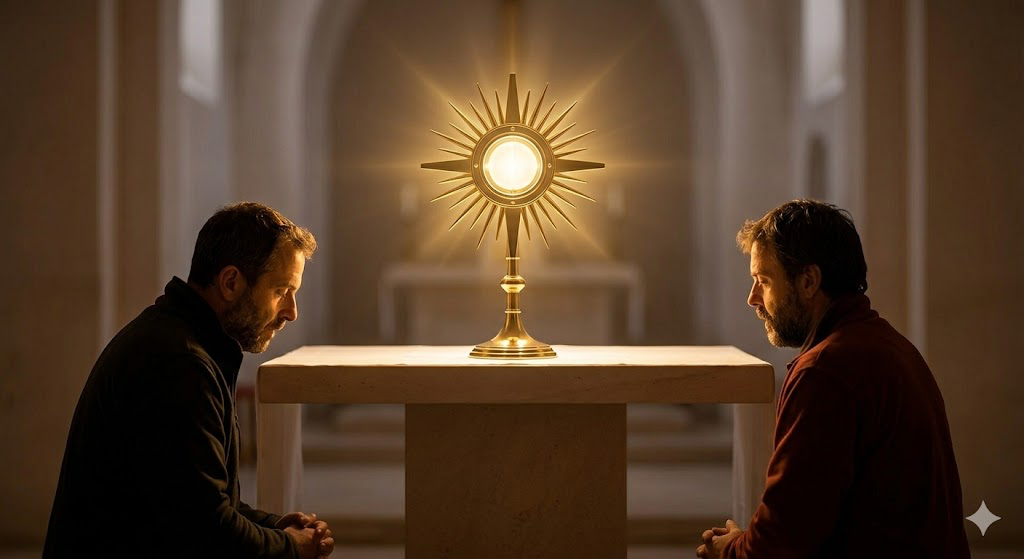
The solemnity of Corpus Christi invites us to celebrate the real presence of Christ.
‘Real presence’ is the unique presence of Christ in the Eucharist under the species or appearances of bread and wine. In other words, because the transubstantiation has occurred, we believe that Christ is truly, wholly, and substantially present in the Eucharist. Hence, the Eucharist is not merely a symbolic or metaphorical presence of Christ but a literal one.
This is why, when we encounter the Eucharistic Lord, we are moved to pray, ‘Stay with us, Lord!’
The three readings of the day help our reflection on the Eucharist.
In the first reading, Moses reminds the people of Israel that God fed their ancestors with manna, ‘a food unknown’ to them. Here, Moses invites them to see the truth that more than merely food for survival, manna symbolized God’s loving care for His people. However, the fact that manna had its limitations (those who ate it eventually died) turns our attention to Jesus’ claim that he is the living bread from heaven. When Jesus makes this connection between manna and his flesh, he lets us understand that manna was merely a foretaste and only his body and blood – the Eucharist – is the fulfillment. Hence, in the Eucharist, we do not merely receive a gift from God but the gift of God Himself.
In the second reading, Paul reminds the Corinthian community that the word ‘participation’ means a real sharing in Christ’s life. He inspires fraternity and communion among the divided and fighting Corinthians by saying, ‘Because the loaf of bread is one, we, though many, are one body.’ Paul wishes the community to break the barriers of difference in families, backgrounds, cultures, and experiences because they receive the same Lord and therefore become one body in Christ. Indeed, the holy body and blood of Christ enable a sacred bonding among his believers. In essence, Paul means that a genuine devotion to the Eucharist always leads to greater love for others.
In the Gospel, Jesus claims that he is the living bread from heaven. It means two things. At first, Jesus, the living bread, becomes the nourishing food for our journey. In Deuteronomy, God gave His people manna to strengthen them in their journey through the desert. But Jesus turns himself into food for us in our journey through life. The Eucharist is not the reward for having completed our journey but the nourishment that enables us to continue it. Secondly, Jesus gives us the promise of eternal life. He claims, ‘Whoever eats my flesh and drinks my blood has eternal life.’ Thus, Jesus’ claim of the living bread helps us realize that the Eucharist is not only the nourishment for today but also a pledge of future glory. The Lord whom we receive in the form of bread and wine is the same Lord we will see face to face in eternity.
A reflection on the meaning of the three readings results in an important question: ‘What happens when we are nourished by the body and blood of Christ?’ In other words, ‘Where do Eucharistic encounters lead us to?’ We may cite three examples.
1. The Urge: The disciples on the way to Emmaus urge the Lord, ‘Stay with us.’ Our genuine encounters with the Eucharistic Lord will turn us into his witnesses. Those who are nourished by the Eucharistic meal are urged to carry the joy of Christ to others.
2. The Hunger: While in John 6:26 we find people following Jesus for wrong reasons, the real Eucharistic encounter with the Lord fills us with a holy hunger. Hence, the more we receive Christ, the more we desire him. The bread from heaven deepens our longing for God.
3. The Action: Mary becomes the best example of the action paradigm. As one who ‘carried’ the Lord in her womb and in her life, Mary constantly moved – to meet Elizabeth, to Nazareth, to Bethlehem, to Egypt, to Nazareth, to Cana, and to Jerusalem. When the Lord dwells within us, we will be constantly moved towards service. In this way, every Eucharistic meal is a call to mission.
Let us pray that the Lord may stay with us to fill us with the hunger and urge for action.
Fr. Dhinakaran Savariyar
Discover more from Gospel Delights
Subscribe to get the latest posts sent to your email.