
Saturday, August 22, 2026
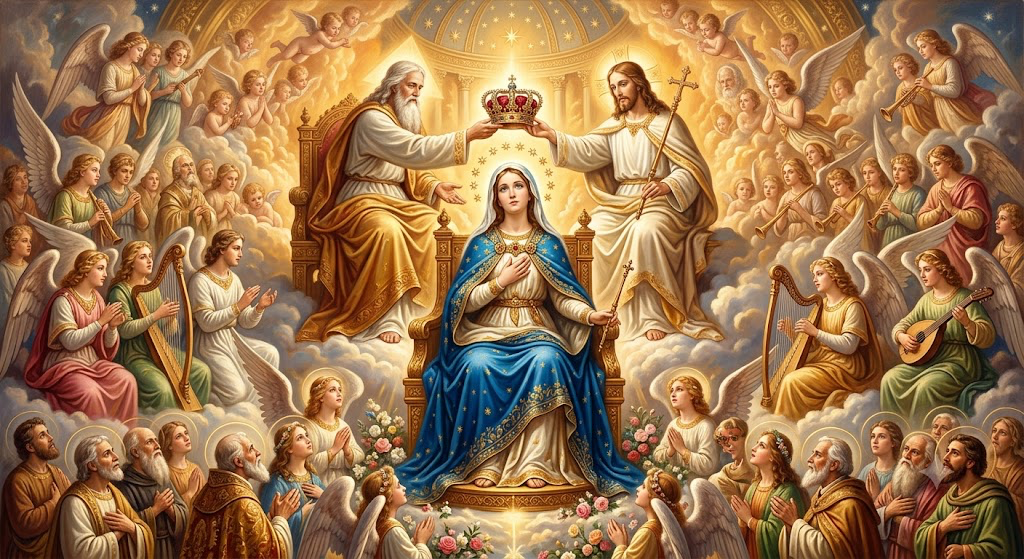
Queenship of the Blessed Virgin Mary
Ez 43: 1-7ab; Mt 23: 1-12
The feast of Mary’s queenship inspires us to respond to God with a heart full of love and commitment.
The feast celebrates Mary as queen of heaven and earth because of her role as the mother of Jesus Christ, the King. Pope Pius XII set this day in 1954, and it is celebrated one week after the Feast of the Assumption.
The idea of Mary’s queenship is tied to Jesus, the King. It is because Mary shares in her Son’s glory that she is hailed as queen as well. The idea of a queen mother is also not strange to the Bible, where the mother of the king held great honor and often acted as an advocate. For instance, we may invoke the name of Bathsheba in the Old Testament. Mary’s fidelity to God is honored through the glory of her Assumption, where the one who reached the perfection of heaven was taken up into heaven, body and soul, and was crowned in glory.
While we may be lost in the descriptions of Mary’s heavenly glory, there is every possibility that we forget what made her worthy to be queen. Hence, as we celebrate Mary’s queenship, we need to understand that her life did not begin with a crown but with a response – her fiat – to God’s will. It is not an ordinary ‘yes.’ In fact, Mary’s response is a profound revelation of her heart. Before we may appreciate Mary’s ‘yes,’ we need to distinguish between an intellectual and heart-level response.
1. What Will I Gain? An intellectual response, one that is founded on solid reasoning, is much needed and well-appreciated because it involves evaluations, comparisons, and calculations. Intellect enables us to weigh the advantages and disadvantages of a decision. Oftentimes, the key questions in any intellectual response will be: ‘What will I gain? What is the cost? Is this worth it? What will happen to me if I say yes?’ While there is nothing wrong with using our intelligence to formulate our response, when we are lost in a ‘cost-benefit’ analysis, it might reduce our relationship with God to mere mathematical calculations. It will be so with humans too. When our response fails to transcend the transactional viewpoint, it will only be conditional, though it is a ‘yes.’ In other words, a transactional approach cannot appreciate the value of commitment or sacrifice.
2. How Can I Love (More)? We are happy to discover that Mary’s ‘yes’ to God’s will satisfies the lacuna that an intellectual response often suffers. For this reason, Mary’s heart-level response is entirely different from an intellectual response. When the Angel of God announced that she would become the Mother of the Son of God, Mary’s heart did not indulge in or perform a cost-benefit analysis. She did not ask: ‘What will I gain by becoming the Mother of God? What will be my privileges and benefits? Is there excessive burden or insurmountable difficulty involved?’ Instead, knowing the heart of Mary, we may safely assume that if she ever asked something, it would have been: ‘What will happen if I refuse to act according to God’s will? What loss will humanity suffer if I do not say ‘yes’ to God’s will?’ This is why when the Angel of God appeared to Mary, she could give a straightforward ‘yes.’ Though what she gave ‘yes’ to was something unfathomable, her faithful heart began to beat for God from that moment on.
Hence, Mary’s faithful and loving response to God calls for an analysis and understanding.
- The greatness of Mary’s response was that it originated in total trust, complete surrender, unwavering faithfulness, and loyal love.
- At the time Mary gave her ‘yes’ to God, she was not aware of her future. The village girl’s heart probably had no idea of Bethlehem or Egypt. She had no way of knowing that her Son would meet a brutal death on the cross. Yet, she gave her ‘yes.’
- The uneducated girl’s heart did not have sophisticated knowledge about her future. Nor could she pick up every clue or connect the dots. Yet her faith in God is seen as she utters, ‘I trust God even when I do not understand anything.’ That is a ‘yes’ from a ‘come what may attitude’ – now, for God.
- Hence, if there is one measure that we can apply to Mary’s response, it is faithfulness. Her heart-level response to God only wondered: ‘How faithful am I to God?’ Hence, her ‘yes’ was not a one-time instance. It became a habitual disposition of her heart. It became a way of life for her.
Finally, if we ask, ‘Why is Mary Queen?’ the answer is, ‘Because she allowed God to rule over her heart completely.’
Let us pray that, inspired by Mary, we may examine our hearts to check our response, its quality, its intensity, and its commitment.
Fr. Dhinakaran Savariyar
Discover more from Gospel Delights
Subscribe to get the latest posts sent to your email.
Thanks for the reminder, Fr. Britto. Blessed Mother truly stands as an exemplary model to deepen our relationship with God.