
Friday, May 1, 2026
Feast of St. Joseph, the Worker
Gen 1: 26b-2:3; Mt 13: 54-58
The feast of St. Joseph, the Worker, invites us to celebrate work as a blessing from God.
How can we find happiness in carrying out the burden of daily work? How can we understand hard work and industry in positive terms? Is there any meaning in labor that wearies human bodies?
All these questions are answered at the feast of St. Joseph, the Worker. Part of the answer comes from the Theology of Work as well.
Catholic theology understands that, with sin, the ‘joy of work’ became ‘toil.’ In other words, the disobedience (‘The Fall’) of Adam and Eve did not introduce work newly but merely changed its nature. Hence, work as such is not described as the punishment for sin, but working by the ‘sweat of our brow’ is (Gen 3:19). God’s people now experience difficulty carrying out what they once joyfully did. The thorns and thistles (Gen 3:18) make the labor of our lives more challenging.
However, through the example of the Holy Family, God upholds the truth that work is not merely a burden to endure but a blessing to embrace.
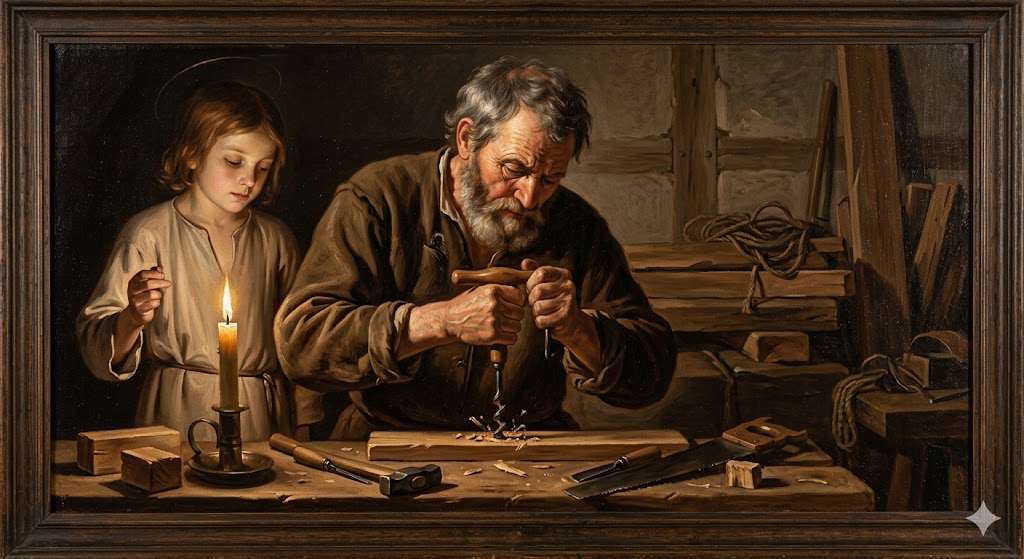
1. Joseph’s Hard Work: Joseph’s hard work as a carpenter was not a curse that he endured. Instead, carpentry earned the Holy Family’s livelihood. It sustained it. Living in a small village like Nazareth, Joseph must have been good at making whatever his villagers needed for farming and other needs. Hence, Joseph’s life became an example that everyday work, like carpentry, can give meaning and fulfilment. It gave the Holy Family dignity and purpose. Through ordinary work like carpentry, Joseph found his way to holiness.
Georges de La Tour’s St. Joseph the Carpenter is a renowned work of art. Three distinguishing features of the painting are important for our consideration. The central theme of the painting is the candlelight illuminating Christ’s face, symbolizing his role as the Light of the World. Secondly, Joseph is seen working with a cross-shaped wooden beam, prefiguring Christ’s crucifixion. Finally, the artist upholds the sanctity of human labor through his portrayal of holy figures in a humble and everyday setting.
2. Mary’s Hidden Labor: Being an ordinary village woman, Mary must have been involved in all household chores. Her role, largely within the house, as wife of Joseph and mother of Jesus, was very crucial. Like Joseph, who busied himself with carpentry, Mary must have run the household while spending much of her time spinning, weaving, sewing, cleaning, gathering food, water, and fuel, marketing, and feeding the house of three. Mary’s hidden work was indispensable for the everyday running of the family.
We may have seen Guido Reni’s Mary Sewing the Shirt for the Christ Child (also known as The Madonna Sewing). The painting portrays Mary not as a queen but as an ordinary woman who is found doing a simple and humanizing act of labor. The painting emphasises the humility and quiet nature of Mother Mary. The painting also symbolizes that, through a mundane task like sewing, Mary discovers the purpose assigned by God. Mary’s everyday work is assisted by God’s grace as well.
3. Jesus’ Trade Lessons: In order for us not to misconstrue work as a curse, the second person of the Trinity was born into a poor family that depended on daily labor for its survival. The Lord, who learned the trade from his hardworking foster father, knew that work retains its dignity, though difficult. It can bring purpose, peace, and joy. Above all, it is a participation in God’s creative activity. Thus, carpentry taught Jesus the value of hard work, which he would eventually transfer to the work of the proclamation of the Kingdom of God.
William Barclay has a beautiful anecdote on Jesus’ carpentry skills. ‘There is a legend that Jesus made the best ox-yokes in all Galilee, and that from all over the country men came to him to buy the best yokes that skill could make. In those days, as now, shops had their signs above the door; and it has been suggested that the sign above the door of the carpenter’s shop in Nazareth may well have been: ‘My yokes fit well.’’
Thus, the feast of St. Joseph the Worker inspires a reflection on the two other persons of the Holy Family and the sanctity of human labor through what they each did to fulfil God’s will.
The feast of St. Joseph, the Worker, invites us to understand our work differently. Whatever work we do – either with our hands, our minds, or within the household – work has dignity.
It also invites us to discover God’s grace that nourishes human life and labor. We are not alone in our hard work. We work with the strength that comes from God.
St. Joseph, the Worker, is a powerful reminder that our daily work can become the path to holiness. St. Joseph, the man of faithful action, teaches that human work is our own way of sharing God’s creative love.
Let us pray that, inspired by the example of St. Joseph, the Model Worker, we may find our work as a blessing of God to enrich humanity.
Fr. Dhinakaran Savariyar
Discover more from Gospel Delights
Subscribe to get the latest posts sent to your email.