
Sunday, May 24, 2026
Feast of Pentecost
Gen 11: 1-9; Rom 8: 22-27; Jn 7: 37-39
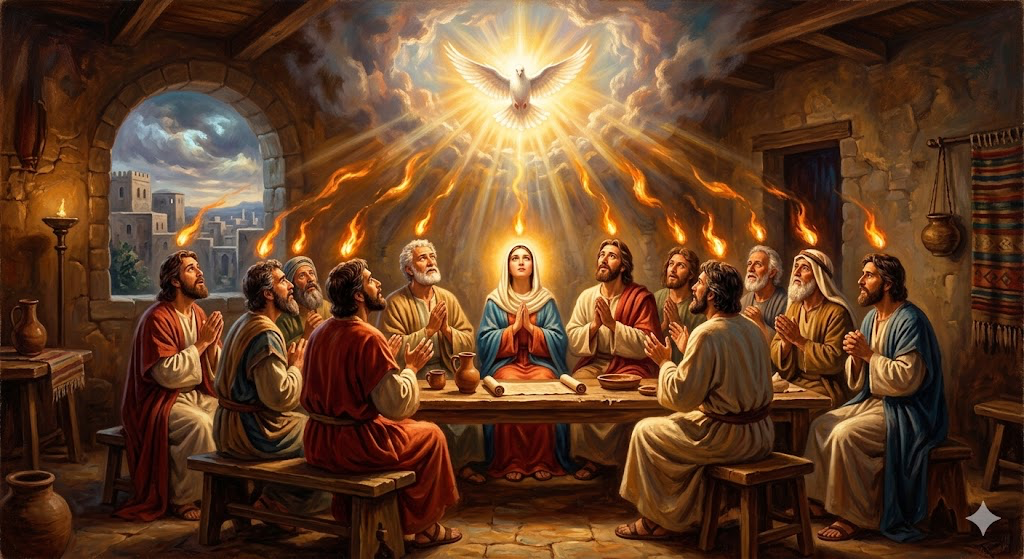
Pentecost Sunday is famously known as the birthday of the Mother Church. This day also marks the beginning of the Church’s mission to the world.
The descent of the Holy Spirit upon the apostles and disciples of Christ fulfils his promise of sending the Divine Helper from above.
The Feast of Pentecost invites us to celebrate the enlivening role of the Holy Spirit, the third person of the Most Holy Trinity. It is very unfortunate that the Holy Spirit is often ignored or forgotten so that we hardly realize the powerful hidden presence of the Spirit in us as He kindles the fire of faith to ever move towards the Lord.
The three readings of the day help our reflection on the workings of the Holy Spirit.
The first reading describes the story of the Tower of Babel. Apparently, the ‘one language’ and ‘common speech’ should have enabled people to communicate and relate better with others. However, what happens is that they are motivated by thoughts of exclusion and self-sufficiency. When God intends a communitarian lifestyle through common speech, they want to defeat God’s purpose by settling for a selfish particularity, which they call their uniqueness by which they will be known. Their act of building the tower contradicts the blessing of God to cherish sociality and seeks individualism that is more inward-looking and self-centered. Their quest for exclusion is clear from their language that puts undue emphasis on ‘us’ and ‘ourselves.’ By this, we understand that they desire superiority, distinction, and control rather than communion. Thus, the Tower of Babel that would ‘reach to the heavens’ was not merely a physical structure but a ‘projection of hierarchy,’ which God resented. When God finds that their unity was rooted in pride, He scatters them ‘over all the earth.’
The reading offers an important insight for our reflection on the Feast of Pentecost. The Spirit of God always inspires unity and communion. He hates division, exclusion, and selfish superiority. Hence, at Pentecost, we find a beautiful reversal of the Tower of Babel. If we see deeply, in the Old Testament, the people spoke one language, which could have led to their unity. Instead, at Babel, one language led to division. But at Pentecost, we find people from many nations, speaking diverse languages and following different cultures, assembled together in Jerusalem. The variety is a sign that they were divided. But when the Holy Spirit descended upon the disciples, everyone heard the message in their own language. Put differently, when one language led to division at Babel, many languages led to unity at Pentecost. Thus, at Pentecost, also the birthday of the Holy Mother Church, we celebrate the fact of the Holy Spirit uniting diverse people into one body of Christ.
In the second reading, St. Paul reveals another important facet of the Spirit’s work: The Holy Spirit strengthens the weak and empowers them. Paul writes, ‘The Spirit helps us in our weakness.’ The Holy Spirit searches our hearts, understands our intentions, and intercedes on our behalf. We feel the Holy Spirit’s intervening power when we struggle in our faith and prayer. Here, we are called to remember Prophet Isaiah’s words in chapter 61:1, which sets the tone for Jesus’ mission in Luke’s Gospel. When Jesus proclaims, ‘The Spirit of the Lord is upon me,’ the words hold true for us too. The same Spirit who ‘led’ Jesus in his mission helps us in our weakness, fear, and despair. St. Paul wants us to open ourselves to the Spirit’s interventions to better our lives.
The Gospel reveals yet another important truth about the workings of the Spirit. If the Christian journey is a constant movement towards the Lord, we cannot make that journey alone without the help of the Holy Spirit. It is the Spirit who guides and leads believers into a deeper communion with God. It is the Holy Spirit who prompts us from within. It is the Holy Spirit who moulds our being into the likeness of Christ. We are confirmed in the Spirit to become mature witnesses of Christ. Just as every aspect of Jesus’ mission was empowered by the Spirit of the Lord (at his baptism, retreat into the wilderness for forty days, etc.), we need the Spirit’s guidance to enable our movement towards the Lord. This is how we feel the enlivening power of the Holy Spirit.
The three readings of the day inspire our reflection on the indispensable role of the Holy Spirit in Christian life.
1. The Spirit People will never be separated by narrow ideologies like language, culture, or country. In contrast, the Spirit people will promote understanding, reconciliation, communion, and love. The Spirit of God is a blessing for our unity.
2. The work of the Spirit is often hidden and unnoticed, very much like air or electricity. Nevertheless, we experience their effects in our daily lives. The Spirit people continue their charity even when unseen, unnoticed, and unrecognized. The Spirit people work for God’s greater glory.
3. The Holy Spirit is our divine helper. The Spirit people are called to realize that we are not alone in anything we do. The Holy Spirit shapes our lives, strengthens our will, and guides our actions so that our lives are in accord with the Lord, just as Christ’s own was.
Let us pray that the Holy Spirit may descend into us to strengthen and unify us.
Fr. Dhinakaran Savariyar
Discover more from Gospel Delights
Subscribe to get the latest posts sent to your email.